Thursday, February 12, 2009

All I Want is a Good Chocolate Shake

Boston City Council President Mike Ross and Councilor Sal LaMattina hit the road last night, presenting their thoughts regarding urgently needed Boston Common improvements at a well-attended community forum.

The forum was hosted by the Beacon Hill Civic Association (of which I am a board member). Several heavy hitters regarding the Common were there, including Henry Lee, the president of the Friends of the Public Garden Group, and Tom Kershaw, owner of the Hampshire House and the man behind the Frog Pong skating rink.

Many of the ideas presented by the Councilors require money that will be hard to raise in the current economic climate, but one of them does not. President Ross said if he were Parks Commissioner, he would immediately put out an RFP for outside interests to refurbish decrepit buildings in the Common and create new restaurants or eating establishments. Such commercial interests would bring new positive activity to the park and make the commercial entity a partner in park safety and cleanliness. I like the idea a lot.

The impetus for Councilor Ross's recommendation is found in New York, where during a trip last year he, Councilor LaMattina and others saw how eateries in a few Big Apple parks greatly enhanced the experience. I wrote last year about experiencing something similar when I bought a cheeseburger and a chocolate shake at the Shake Shack in Madison Square Park. That place is so popular there is a web cam online that monitors how long the line is.

We will see what happens next with Councilor Ross's plan for the Common.

City Council President Mike Ross (standing in back) addresses a group at the 74 Joy Street building, Beacon Hill. To his right is Councilor LaMattina. Standing to the right of the photo is Colin Zick, chairman of the BHCA Parks & Open Spaces Committee. Seated is Henry Lee.
Beacon Hill, Boston
February 11, 2009

Sunday, February 08, 2009

Sam Yoon Enters the Boston Mayoral Race

Here we go.

Three candidates have now declared they will run for Mayor of Boston, as current Boston At-Large City Councilor Sam Yoon announced his intentions today. He joins his colleague Michael Flaherty and South End businessman Kevin McCrea as announced candidates. Assuming all three candidates get enough signatures when candidate papers are filed in April and May, there will be both a preliminary and general election in the fall to pick the Mayor.

Of course, the current Mayor, Tom Menino, has not announced whether he will seek re-election.

Yoon is a young city councilor with a promising career, but there should be emphasis on the word "young." I have significant concerns about his lack of experience, and I hope citizens will not be swept up in the current trend of change to overlook the need for experience in today's difficult times. (See my earlier post discussing the slippery slope of political "change.")

Saturday, February 07, 2009

Boston Ward 5 Democratic Caucus; Convention Here I Come

This morning at Boston's Ward 5 Democratic Caucus, I was selected to be a delegate to attend the Massachusetts Democratic Convention in Springfield, to be held in June. It will be my second Convention. I am excited to attend along with the full slate of Ward 5 and Boston delegates, including Josh Dawson, George Alex, Jim Ryan, and Rajan Nanda.

The caucus was more exciting than I expected. Attendees were greeted at the door by a representative from Boston City Councilor John Connolly's office, who distributed a letter from the Councilor as well as a recent clipping from the Bay State Banner. In addition, two volunteers stood at the door holding campaign signs for Aaron Michlewitz, who is running for the State Representative seat vacated by former House Speaker Sal DiMasi.

I have to say, it's somewhat impressive to see Aaron Michlewitz as organized as he is. Sal DiMasi's former district includes one lonely Ward 5 precinct (out of 11 precincts total), and yet his volunteers were very visible this morning.

Ward 5 Democratic Committee Chairman Rob Whitney noted at the caucus that the committee would be discussing a game plan related to the election that will fill DiMasi's House seat at its next meeting, scheduled for February 17. At that time, the Committee will discuss a possible candidates forum and endorsement vote to take place at a later date, assuming additional candidates enter the fray (and rumors were flying at the meeting about who they might be).

Representative Marty Walz noted that the special primary to pick the Democrat running for that seat will be held on May 19. The special election itself is scheduled for June 16.

Sunday, February 01, 2009

The Lonely Road

At route 89 mile marker 29.
Randolph, Vermont
February 1, 2009

Saturday, January 31, 2009

Killington '09


L to R: Glenn Tanzman, Jody Paglia, Melissa Nuttal, Tim Wilson, Sarah and Paul McNeeley (I am behind them), Tim and Priya Stoll.
Killington Weekend '09
Killington, Vermont
January 18, 2009

Happy Super Bowl Weekend

I made the trip this morning to Sugarbush Mountain in Fayston, Vermont, and I am sitting at the kitchen table of the infamous Chipotle Ski House, owned by Scott Cullen. I met Scott several years ago when we were in a ski house together (a house aptly named "The Farm") in Waitsfield, a town just north and east of here.

On the way up from Boston this morning, I listed to NPR, which is rare for me. During this week's episode of "Only A Game," a segment discussed the recession's impact on Super Bowl weekend.

That's right, it's Super Bowl weekend, which I love. The food and football is very attractive, but I have always been impressed by how the NFL has made Super Bowl Sunday a national holiday. Tomorrow I plan to attend a Super Bowl party in Boston... but I digress.

On NPR, they talked about the recent financial pinch has lowered the ticket price if one wants to attend the game in Tampa (down to $1500 from $2 grand. Yep a real bargain!). Then came a great comment by Keith Olbermann, the former sports announcer turned MSNBC host, who said, to paraphrase, that you can watch the game at home for free, which might be very important now given the economy.

It's a great point. The Super Bowl is a self-made event that can be made a party with simple food and beverage. I imagine many this year will welcome the inexpensive distraction.

Wednesday, January 28, 2009

The Men With Heart Team

Men With Heart Team Members Scott Walters (l) and Paul Boulanger
Kingfish Hall
Boston
January 26, 2009

Back in 2001, I joined team of phenomenal men, when Paul Boulanger (in the right of the photo above) created Men With Heart. The team's story is a simple one. Paul walked in 2000 in the then Avon 3-Day Breast Cancer Walk in Boston, alongside his wife, a breast cancer survivor.

Looking around, Paul didn't see many men. In fact, he didn't see any.

Alarmed, Paul decided to get men involved, and the next year, more than 40 males (I among them) joined the walk. Wearing our signature yellow t-shirts and smiles, we marched from Fitchburg to Boston.

Since then, Men With Heart has raised more than $800,000 in the fight against breast cancer, mainly by sponsoring walkers in major breast cancer walks, including the now Komen 3-Day and the 2-Day Avon Walk for Breast Cancer.

This past Monday, I attended the Men With Heart kick-off meeting, which for several years has been held at Kingfish Hall in downtown Boston. It was the first time I had been to a team event in years (though I still receive the team's regular emails), but I felt like I never left.

It's impossible to put in words what it's like to participate in one of the multi-day breast cancer walks as a member of Men With Heart. If you are looking for a cause in 2009, I encourage you to visit the team's website.

P.S. Ask my friend Tom Hopcroft or I some day about day two of our first 3 Day. When we walked in snow. In May. And we were inspired by every minute of it.

Sunday, January 25, 2009

The Slippery Slope of Political "Change"

A word that emerged on the scene in 2008 was Rorschach, as in Rorschach test. I had no idea what it meant before the 2008 election season, and now I read analogies using the Rorschach test every week.

The Rorschach test implies that a given political candidate turns into what the voter wants. It's often related to President Obama. Voters saw in Obama what they wanted, given his fresh face at a time of national political despair (read "George W. Bush").

Put another way, if voters want change badly enough, they will embrace a change candidate for their own reasons.

It follows that in this current political climate, candidates are desperate to be seen as agents of change.

Enter Michael Flaherty, and his announcement today (or was it late last night?) that he's a candidate for Mayor of Boston (2009 is a Mayoral election year in Boston). The text on his campaign website does not mention "change" at all, however he couldn't help himself on the YouTube video that officially declared his intentions. He asks listeners to consider joining his "campaign for change."

It's a grassroots effort. It's time to turn the page. Start a new chapter. Bring in new leadership.

All these phrases are indicative of calling for change. Flaherty, currently a Boston City Councilor, is hoping that by being the change candidate, he can lump Mayor Menino (assuming he decides to run for re-election) into the same category as George Bush, Dianne Wilkerson, and others-- cases where the voters believed it was time for change.

Flaherty assumes that change in leadership is needed. Unfortunately for him, Mayor Menino is not George Bush, and he is not Dianne Wilkerson. He is not to blame for the current economic crisis faced by the city, the nation and the world.

In fact, one would argue that given what we will face in the coming months, experience is what is needed so that this city is properly represented. Mayor Menino's most recent announcements make it clear he is acting in the best interests of Boston.

The 2009 Boston Mayoral race has begun, and we have two announced candidates-- Flaherty and South End resident Kevin McCrea. Both will inevitably talk of change. Merely calling yours a campaign for change does not make it a Rorschach test for voters. In the case of Obama, voters were thirsty for a change, and someone who could provide new ideas. In Boston this year, we need experience, wisdom and leadership. Change can result in the opposite.

Saturday, January 24, 2009

A New Day For Amercia and the World

Eight days before Barack Obama became the first African American with a desk in the Oval Office, Tony Dungy retired as the head coach of the Indianapolis Colts. I respect and admire Tony Dungy, even though I don't root for his team. He led his squad with class and dignity, and players and colleagues universally respected him. The understated nature of his retirement, ahead of the off-season, while the league was distracted by the playoffs, probably was to his liking.

Tony Dungy was the first African-American head coach to win the Super Bowl. Merely days before Dungy's NFL Championship against the Chicago Bears in 2007, I listened to "Mike and Mike in the Morning" (ESPN Radio) discussing one fact about the game that was overlooked-- BOTH head coaches were African American (Lovie Smith coached the Bears in that game). Mike Greenberg and Mike Golic seemed somewhat amazed-- and to some extent apologetic-- that they weren't talking about that fact more. It appeared no one really was. The fact that an African American coach was going to win football's most important contest... well, it just didn't seem to matter.

Wow, has this country come a long way in a short period of time. Barack Obama is the first African American President of the United States, and his skin color just doesn't seem to
matter. No one is talking about the Bradley effect anymore.

Obama never really made race an issue in the campaign. He never had to. His message resonated across party and racial lines. He brought a fresh, young face to a country that desperately needed to see it. His words changed little from the very beginning of his campaign to Tuesday's inaugural speech. It's going to be hard and it's going to require sacrifice, but we will get there.

The enormous crowd assembled on the Mall in Washington saw citizens of every heritage and ethnicity.

President Obama hugged his half-sister, Maya Soetoro-Ng, at her December 2003 wedding to Konrad Ng, third from right, in Hawaii. From left, his daughters, Sasha and Malia; his grandmother Madelyne Dunham, seated; Konrad’s parents, Joan and Howard Ng, and brother Perry Ng; and Michelle Obama.

Among the many photo montages online, I spotted this photo on Tuesday. It was taken in December 2003, at the wedding of Barack Obama's half-sister, Maya Soetoro-Ng, in Hawaii. [Sidenote: President Obama has several half-siblings. Maya was the President's mother's second child. The President's dad had four children prior to marrying the President's mother, and he had three children and two wives after returning to Kenya.]

The picture demonstrates clearly what President Obama represents, and what the United States has become. A true racial mix. The photo includes President Obama and his daughters, as well as his half-sister (born in Indonesia), his half-sister's new husband and in-laws (Canadian), his grandmother (born in Kansas), and his wife (born in Chicago).

President Clinton said many times in the 1990's that the biggest asset to this country is our racial diversity. The fact that we can overcome racial divides when the cause and time are right. The time is right today, and the cause is urgent.

EDITOR'S NOTE: Photo taken from a must-read story: "Nation's Many Faces in Extended First Family," by Jodi Kantor, New York Times, January 20, 2009.

Beyond the issue of race, the magnitude of the power transfer on Tuesday is unimaginable to me. From the moment they met Tuesday morning for coffee, to the warm and seemingly genuine embrace when the departing President boarded the Marine helicopter, it was easy to overlook the dramatic rift between the outgoing and incoming Presidents.

They disagree on many issues, and yet the peaceful transfer of power happened, based on what out of context would be called arbitrary words on a random piece of paper we call the Constitution. In no other country could such an event take place.

President Obama got to work quickly, dismantling the many processes that his predecessor put in place. Despite the radical shift, his decisions were respected. The military trials in Cuba, created by President Bush, were halted, literally in mid-proceeding. With the stroke of a pen, the controversial overseas CIA prisons were closed (though President Obama can use them again if he wants), and CIA interrogation practices were limited to the same code of conduct the military follows (Sidenote: A law to codify this failed to pass Congress last year; John McCain was among those who voted against it).

Signatures are ink. Executive orders are written on paper and are mere letters. But Obama's signature instantly took on the weight of the President's office at exactly noon Washington time Tuesday (regardless of when he took the oath, he took office at noon). As overlooked as the color of his skin is the fact that Obama's early orders-- so dramatically different than just a few short hours earlier-- were accepted, immediately, as a matter of law.

The inaugural events overshadowed another dismal week for the American economy. Large banks continue to wither; talk commenced this week of the U.S. government taking over major financial institutions altogether. The unemployment rate rises and mortgage foreclosures continue.

Yes, we need President Obama now. And the nation stands behind him.

Friday, January 16, 2009

Enforcing Green Tickets in Boston

A law awaiting signature on Mass. Governor Deval Patrick's desk will make the streets of Boston much cleaner.

The Boston Inspectional Services Department (ISD) issues tickets to those who improperly dispose their trash. If they spot a bag of trash put out on the street on a non-scheduled trash pick up day, they will dig through the bag of trash, find a piece of mail to identify the owner, and write a ticket for the offender. Around the city, they are known as "green tickets." That color ticket is issued by ISD.

It's dirty work, no pun intended, but it is extremely important. Boston residents are notorious for ignoring the rules regarding trash pick up, which are already very generous. Generally, neighbors can put trash on the street after 5 p.m. the day before trash is collected. As pick up begins at 7 a.m. in the morning, this means refuse spends up to 14 hours on the side of the street.

On Beacon Hill, neighbors have proposed innovative programs to restrict the pick-up rules. Many, including your truly, wait until the morning to put out our trash. We have trash pick up three days a week, so these efforts are meant to curtail the significant amount of time that the streets are untidy.

Earlier this decade, The Beacon Hill Civic Association asked the city to enforce what's called "same-day pick up," which means that trash cannot be put at the curb until midnight on the day it's collected. We asked for this within Beacon Hill only. It was an effort I supported and was a part of, but it ended up being a miserable failure.

To my disappointment, many of my neighbors don't mind seeing trash on the street for 14 hours ahead of pick up, despite the obvious advantages of the trash not being there. Despite the BHCA's best efforts, we were unable to inform many residents on the north slope of this program. The reasons for that disconnect would cover several other blog posts.

And, perhaps most importantly, the City of Boston has trouble enforcing the green tickets it issues, and for no fault of its own. There are many reasons why, but a dirty little secret in Boston is if you receive a green ticket (as opposed to an orange parking ticket), you can just ignore it and you will probably not hear about it again. I used to joke with people that the best thing to do with a green ticket trash violation is put it in the trash.

However, my legislators, in particular my City Councilor Mike Ross and my State Representative, Mary Walz, are attempting to solve the green ticket problem. They are pressing legislation that allows the City to connect the green ticket violations directly to property holders. It would allow the city to hold the property holders accountable by placing liens on their properties as a result of unpaid green tickets, similar to how unpaid parking tickets can be attached to eligibility for a driver's license renewal.

The bill is on the Governor's desk this week for his signature, and my neighbors urge him to sign it.

The BHCA is thinking about starting anew with a same-day pick up program. We've learned from our mistakes, and the education effort in the community for this second attempt will be massive. But without more effective green ticket enforcement, it's hard for the city to help us.

Governor Patrick: Please sign the bill.

EDITOR'S NOTE: Governor Patrick did not sign the bill, and it was therefore subject to a pocket veto.

Thursday, January 15, 2009

Random Fact About Bottled Beverages

Did you know that some plastic bottles are sanitized before filled with liquid, and others are not?

I learned today that carbonated water does not allow bacteria to grow, and that pure water has the same effect, because it does not contain sugar.

However, for other beverages in bottles, such as Gatorade and fruit drinks, the bottle needs to be sanitized. Many beverage manufacturers will either use chemicals or they will heat the liquid before it is placed in the bottle. This results in a sanitized plastic bottle that can be filled with the liquid

How about that? Just a random fact I learned thanks to my job.

Sunday, January 11, 2009

Happy Birthday, Annmarie

Annmarie Connors
January 10, 2009
Vox Populi
Boston, Mass.

Saturday, January 10, 2009

Legislature says: Let's get moving!

This week I attended two events to kick off the 2009 legislative session.

On Monday, my City Councilor, Mike Ross, was elected Council President, and I attended the first council hearing of the year at City Hall, where the vote took place. A few observations:

-- Hats off to the Councilor's staff for coordinating the offline and online worlds so well. While Ross addressed the Council from the rostrum, his staff launched a new campaign website and posted a blog entry via Boston Magazine online (Ross has penned a blog there for many months). Even better yet, the messaging across all the vehicles was in sync.

-- Ross pledged to make the Council more open to all residents, both by using technology better and by holding council meetings in Boston's neighborhoods. I am not sure how the second idea would work logistically, but it makes sense. It's hard to attend City Council hearings during the day. Also of note, Ross addressed the issue of electronic access in his blog post, a wise move given it's an area of contention for many active Boston bloggers.

-- Ross proposed an economic summit of City leaders, modeled after a volunteer summit organized by the previous City Council President, Maureen Feeney. A summit to think of ideas is always a good idea. Let's hope it happens soon, given the economy is in rough shape, and I for one am ready to do whatever I can to put the resulting good ideas into action quickly.

-- The Council Chamber buzzed with energy, both because of the youth of the new President, and also because embattled City Councilor Chuck Turner led the session until Ross was elected.

-----------------

On Wednesday, I trudged through the snow, sleet and rain to watch the swearing in of my new State Senator, Sonia Chang-Diaz, at her new office at the State House. It was my first trip ever to the State House, and it allowed me to reminisce with other campaign volunteers and staffers, such as Deb Shah and Marianne von Nordeck. I snuck out of the office during the proceedings to visit with fellow Ward 5 member Laura Sargent, who works for my State Representative, Marty Walz.

Witnessing my first Senate proceeding was at times, well, comical. One of the more perplexing ceremonies of the day? How about when the Senate Leader appointed a committee of other senators to escort the newly elected Senate President, Therese Murray, to the rostrum. I guess there's concern the Senate President might get lost?

Pomp and circumstance aside, the new state and local legislative sessions have begun, and at a time when it's got to be challenging to be an elected leader. Still, what I witnessed gave me a sense of optimism. President Ross and President Murray both noted the *urgent* need to get moving for their constituents. (Mayor Menino and Governor Patrick echoed these sentiments when they addressed the respective chambers.)

The sessions have gotten off to a fine start. After all, President Murray found her way to the rostrum, thanks to a committee of her colleagues. Definitely a good sign.

Sunday, January 04, 2009

Lobster Fest

Nikko, Jen and I traveled north yesterday to capitalize on the relatively cheap price of lobster.

There are several ways to eat a lobster. A brief review of two on display yesterday:

1) The scavenger (Nikko's approach): Lobsters contain meat in weird places. Typically I leave the meat in the head and chest cavity of a lobster alone. I figure the law of diminishing returns dictates it would take a lot of effort to extract a small amount of meat. Nikko, however, prefers to eat as much of the meat on every lobster. I admire her resourcefulness.

2) The butter soaker (my approach): Recognizing that the lobster in many ways is just a butter delivery device, I tear apart the lobster meat and let it sit in the butter for thirty seconds or so before I consume it (I hope my doctor isn't reading this).

There are also several ways to find lobster. You can buy your own and cook it at home, which is the cheapest method. You can go to a restaurant for a more elegant experience. Or you can travel to a "lobster pound" (basically the place where the lobsters go after they leave the boat). Many lobster pounds in New England have their own dining rooms where they serve lobster and various fried seafood items.

Yesterday, we went to two lobster pounds north of Boston. First, we crossed the New Hampshire boarder and visited Brown's in Seabrook. Here's my review:

Positives (+)

-- They crack the lobster shell for you, making it far easier to eat.
-- They sell several lobster sizes. Generally I aim for a smaller lobster (buying more than one as necessary), as the meat is more tender.
-- The view was awesome.
-- The picnic benches in the dining room felt authentic.

Negatives (-)

-- The clam chowder left a lot to be desired (Jen called it potato chowder).

Second, we drove a few miles south, back into Massachusetts, to find Bob Lobster in Newbury.
Again, my review:

Positives (+)

-- You might get to see Bob (we didn't, but we were told he often comes in).
-- They give you a lobster cracker.
-- They provide a bib (Brown's did not)
-- Again, multiple size lobsters.
-- They sell desert (ice cream!)
-- The dining room has a fireplace (fake wood, but still, pretty cool)

Negatives (-)

-- The lobster shell wasn't cracked, so it was harder to eat (no injuries were sustained)

As you can see, in both cases, the positives outweighed the negatives. So if you are in the area, you should check them out.

By the way, there is an interesting article on Slate.com that talks about why the prices on lobster are low. Enjoy!

Wednesday, December 31, 2008

Big Issues of 2009 Already Taking Shape

Only a few days after posting my own thoughts on the big Beacon Hill issues to close out 2008, and we're already getting a peak at the issues that face us to start 2009.

1) A neighborhood school downtown. A story in the new edition of the Beacon Hill Times talks about a new community movement afoot in the West End to build a new public elementary school as part of Government Center Garage proposed project. The story in the Times includes a photo of West End parent Chiara Rhouate, who is apparently leading a group called The Coalition for Public Eduction: Expanding Quality Education for Downtown Neighborhoods, which already has the support of new President of the West End Civic Association, Duane Lucia.

It will be interesting to see if the new group gains support from parents on Beacon Hill, who no doubt are still recovering from a campaign to bring a public school to their neighborhood. A few years ago, some Beacon Hill neighbors pressed the City to convert a former Emerson dormitory on Brimmer Street into a public school. The City opposed the idea, and today that building is a private school.

The issue of a neighborhood school raises a lot of emotions that often overshadow the very nature of the Boston Public School system, something even I don't fully grasp. But I know enough to understand that even with a local elementary school, parents are in no way guaranteed that their children will attend there. The Boston Public School system uses a lottery to determine the schools children will attend.

2) The deterioration of Downtown Crossing. A post on Universal Hub best summarizes concerns about crime in the Downtown Crossing area, given the economic crisis and the fact that many retail storefronts along Downtown Crossing streets are empty. Gunfire in broad daylight last Friday has risen the recent concern.

You can bet I will be watching both these issues closely in the weeks to come and will be adding my own thoughts as I learn more about them.

Sunday, December 28, 2008

Top 5 Beacon Hill Issues/Stories to Finish 2008

With less than a week to go in 2008, I take a swing at summarizing the top five news stories or issues that have affected my neighborhood of Beacon Hill from July 1, 2008 until today. I created a similar list to review the first six months of the year, which I posted at the end of June. I figured I would start a tradition.

Here goes:

5. Street lights. Beacon Hill residents take sidewalk space very seriously, since we don't have much of it. Boston Transportation officials negotiated with the Beacon Hill Civic Association to install new street lights on Charles Street, replacing old mechanical devices with new digital ones that are connected to a central location where city officials can monitor and manage them. The problem was the new lights brought with them boxes that ate up valuable sidewalk space. Ultimately, the Beacon Hill Architecture Commission gave the green light on the project, and most of the lights on Charles Street have been upgraded.

4. The completion of Cambridge Street. It's finally done. Cambridge Street renovations, performed by the State but designed by the City, finished over the summer. More importantly, a public-private partnership with the City has emerged to maintain the plantings down the center of the street. The partnership includes the Cambridge Street Development Corporation (CSDC), funded by businesses on the street. My friend Ted Furst is among the volunteers on the CSDC, and he represents the Beacon Hill Civic Association. From what I understand, the completion of the Cambridge Street renovations ends a decades-long effort. My neighbors Peter Thompson and Karen Cord Taylor were among the most passionate shepherds of the project.

3. Clark Rockefeller. In late July, he allegedly kidnapped his daughter, Reigh Storrow Mills Boss, from their Back Bay home and fled the city. The story hit very close to home. While Rockefeller did not live in the neighborhood, he spent a lot of time on Beacon Hill. The infamous picture of him and his daughter outside a church was taken by a photographer hired by our very own Beacon Hill Times. Stories of Rockefeller sightings surfaced everywhere. He apparently attended the Beacon Hill Civic Association Winter Dance last year at the Liberty Hotel (an event I also attended). He apparently held meetings with various individuals at the Starbucks at the corner of Beacon and Charles.

2. The proper use of the Boston Common. Almost all of Beacon Hill is represented in the Boston City Council by Councilor Mike Ross, soon to be the President of the body. One of Councilor Ross's big issues in recent months was the use of the Boston Common. Along with other Councilors, he issued a report in December that provided recommendations on changes to the Common. He suggests a commercial eatery on the Common, for example. He also created somewhat of a controversy by suggesting that the Common be managed by a public-private partnership (the final set of recommendations did not contain this recommendation). The Boston Common promises to be a big issue in 2009 and beyond. The public park is heavily used, and a master plan related to the Common is incredibly out of date. A discussion on such a public space will raise many related issues, among them spending priorities given recent economic troubles, the role of public-private partnerships in managing spaces open to all, and the needs and rights of our neighborhood's pets (a dog run is among the recommendations made by Councilor Ross's committee).

No doubt you will be reading more about all of these issues on this blog in the weeks ahead.

1. The 2008 Election. The end of the year wraps up my first calendar year as a member of the Ward 5 Democratic Committee. What a year it was. Most of Beacon Hill is represented by the 2nd Suffolk Mass. Senatorial seat, a seat that was highly contested this election cycle. Sonia Chang-Diaz, a challenger and former school teacher from Jamaica Plain in Boston, defeated the sitting State Senator, Dianne Wilkerson, in the primary and went on to win in the general election. Along the way, Chang-Diaz earned significant support from Beacon Hill, where she won better than 60-percent of the vote in the primary.

The Presidential election also energized Beacon Hill. Hundreds of residents traveled north to New Hampshire during the election season to volunteer. The neighborhood is heavily Democratic, and Barack Obama signs were visible in many windows, some even hanging from window flower boxes. Lines at Beacon Hill's four voting locations (West End Library, the State House, City Hall and The Hill House) swelled during election day. The election's energy has given many a reason to be optimistic, as we look ahead to the beginning of 2009.

Happy New Year, everyone!

Wednesday, December 24, 2008

Signs of the Times

Mike's Pastry
Hanover Street
Boston
December 24, 2008

Annual rituals die hard. This afternoon, hours to Christmas Eve, I walked to Mike's Pastry on Hanover Street in the North End to pick up a dozen cannolis, assorted. It's what I have brought back to Christmas dinner in Connecticut for many years. I leave in less than an hour to drive south to meet up with my parents.

There is an art to buying at Mike's pastry the day before Christmas and Thanksgiving. You need to feel the crowd and the lines, and look for a "soft spot" where the attendant-to-customer ratio is the highest. And if you are at all interested in the last sentence, then you know I tend to spend a lot of time in line a Mike's, allowing me to think of concepts such as an attendant-to-customer ratio. Success was had, however.

In the conversations leading up to the holidays this year, I was somewhat confused talking to my friends about going "home." To me, home is Boston, but to many of them, "home" is the house they grew up in. I call that location "home home," but not many of my friends understand the semantics.

To all out there reading this, I wish you a very safe, healthy and happy holiday break. Merry Christmas!

Saturday, December 13, 2008

Reflections on being in the air, from the ground

I traveled quite a bit in 2008. There was the 10-day trip to London. The series of trips to San Francisco. Four trips to Austin. The most recent swing through Florida and Texas. You know you travel a lot when you start reading the "Itineraries" section in the New York Times regularly.

You also know you travel a lot when you have gripes.. errr.. suggestions for the airlines. Suggestions is probably a better term. My dad always says that with the airlines, you get what you pay for, and one cannot expect to receive a wide seat, free amenities and service with a smile while also demanding the cheapest rate for a ticket.

He also tells me that a large percentage of an airline's operating budget is spent on jet fuel (He should know, he's a retired aerospace engineer). So why is that while the price of fuel has dropped more than 50-percent in recent weeks, I still have to pay for bottled water on USAir?

My most recent trip shows the various ways airlines have started charging fees.

I flew JetBlue from Boston to Fort Lauderdae. Free soda, no charge for a checked bag, and a fairly comfy seat. I know that JetBlue charges for headsets and pillows, but I didn't need to make a purchase.

I flew Continental from Fort Lauderdale to Austin. Free soda, a 15-dollar charge for a checked bag, and packed in like a sardine can.

I flew USAir from Austin to Boston. No free drinks (2 bucks for a bottled water, in my case), a 15-dollar charge for a checked bag, and the seat was ok.

On my first flight ever as a kid, from Bradley field in Windsor Locks, Conn. to Chicago, I remember cringing when the drink cart came by. I wanted a soda, but didn't want to have to ask my parents to buy me one. "Go ahead," my dad said. "It's free." Those days are quickly going buh-bye.

The reality is while the charges are inconvenient, I will most certainly fly USAir or Continental again if the price and schedule is right. Which I guess proves my dad's point-- it all comes down to who offers the lowest fare.

One thing I cannot understand at all is why airlines charge for checking a bag. As if passengers needed additional incentive to bring their bags onto the plane and try to jam them in the overhead compartment. I typically am assigned an aisle seat, which means in most cases I get on the plane last (airlines with zoned-boarding assign later zones to those sitting on the aisle to speed up the boarding process). By the time I get on the plane, there is no overhead space. I always check a bag, so I am stuck with no overhead space after paying to have the bag flown with me to my destination.

There really is no incentive to check a bag. Even if you get on the plane and find no room for your roller-style suitcase, they will "happily" gate check it, put it on the plane right before they close the cargo door, and the bag is waiting for you as soon as you get out of the plane and onto the jetway. What service! And for f-r-e-e free.

It should be the other way around. They should charge passengers to bring a bag ONTO the plane. Business passengers would still pay, and passengers would receive an incentive to check a bag and make the cabin experience better for others.

In reality, I really don't have much to complain about. I have no real airline horror stories. Most of my flights are on time. And I have only lost my bag once. But a friend recently told me that the airlines design airline seats for individuals much smaller than the average sized person today. Guess that tells me where I stand on the totem pole, especially if-- I admit-- all that matters is price.

Oh and by the way, no more travel for me until next year, except in my Honda.

Sunday, December 07, 2008

Holiday Decorating Days on Beacon Hill

L to R: Me, Karin Mathiesen, Councilor Mike Ross, Ted Furst, Lori Bate, Michelle from Mike Ross's office
Charles Street on Beacon Hill
Boston, Mass.
December 7, 2008

Without question, it's my favorite neighborhood event. For two days in early December, neighbors throughout Beacon Hill come out, climb up ladders, and decorate the more than 1200 lamp posts that line the historic streets.

Sounds easy, right? Well, when the entire volunteer effort begins during the fall, when the Beacon Hill Civic Association solicits donations to pay for the greens and bows that ultimately hang on the lamp posts.

Then there's decorating day weekend itself, spanning two days and involving more than 100 volunteers. I love the weekend because everyone is so happy and full of Christmas spirit. I also love it because I meet several new neighbors each year.

I also think the event represents the best of Beacon Hill. Neighbors come out and help each other to make the streets look great. It also coincides with the annual tree sale at the Hill House, which includes Christmas carolers. You can't get any better than that.

Decorating days always take place a few days before the Beacon Hill holiday stroll, which is scheduled for Thursday. It's when Charles Street is closed to cars, and the shops stay open late. We light the neighborhood Christmas tree (provided by the City of Boston), and you will probably spot a caroler or two. Not to mention very decorative lamp posts all throughout the neighborhood.

A couple of side notes: Hats off to Historic New England. I became a member this weekend. The house they manage, the Otis House on Cambridge, is the center of operations for Decorating Days. Also, the van in the picture above, which I drove delivering greens with Ted Furst throughout the weekend, once belonged to a Banjo group that appeared on the Letterman Show.

Sunday, November 30, 2008

Somebody in my Hometown is Pretty Ticked

Franklin, Conn.
November 27, 2008

I don't know the circumstances, but it certainly sounds like Bob is pretty upset. Does he really expect the perpetrators who are stealing his topsoil and wood to call him with questions?

This sign is at the entrance to a new housing development around the corner from my parents' house in Connecticut.

Saturday, November 29, 2008

The Day The Tower Fell

Boston University Campus
Boston, Mass.
November 29, 2008

It's almost as if they wanted it done by the dark of night. The radio antenna above the Boston University College of Communication came down today, on a Saturday when most of the campus was empty, the students still away celebrating the long holiday weekend.

Not that the moment really means much to non-BU students and grads. The eye-sore antenna hasn't been functioning since the 1950's, and back then, WBUR (now Boston's NPR affiliate) was the University's student radio station. However, the tower symbolized COM, as we all call the College. Its removal has sparked somewhat of a debate on campus, since the BU president recently ordered a construction freeze. A well-written story in BU's student newspaper, The Daily Free Press, talks about other unsightly architecture on the campus that should face a similar fate, even during the freeze. (I love the reference to tearing down the BU Law Tower; as the famous BU joke goes: "The best view of Boston is from the high floors of the BU Law Tower, because you can't see the Law Tower.")

I saw the antenna coming down today as I was walking from Louie's, where I have gotten my hair cut since I started at BU. Maybe only a BU COM grad can understand, but it was somewhat of a poignant, if accidental moment. We recognize COM by the antenna in diametrically opposed ways. You think radio, of course, when you see it, but its derelict status always reminded the COM student of the equally decrepit halls of the building itself.

Sunday, November 23, 2008

Week of My Favorite Holiday

Thanksgivig is by far my favorite holiday. There are several reasons why.

First, Christmas gift-giving can be as much a pain as it is a blessing. I love buying gifts for family, but sometimes I forget to buy a gift for a relative who decides to show up for dinner. While I am sure everyone understands, the stress freaks me out. There are no gifts at Thanksgiving. Which also means no debates about who got the worst gift.

Second, it's impossible to offend anyone by saying Happy Thanksgiving. I can't even begin to count the number of times I have put my foot in my mouth by saying Merry Christmas to a non-observer. Thankfully, many of those who do not observe, and have received my cheery quip, have simply accepted it and not pointed out their beliefs. I thank them for that.

Thanksiging is an American holiday. There's something under the surface that's patrioitic about it. It also celebrates our diversity. I love talking to neighbors from other parts of the country about their side dishes at Thanksgiving. Or the family Thanksgiving dessert that has been in a given lineage for generations. For my family, it's English-style fig pudding and English Bakewell tarts, courtesy of my great-grandmother's relatives.

Third, Thanksgiving falls on a Thursday, so the mini-holiday-inspired vacation always begins with the holiday. You celebrate Thanksigivng, and then you have a couple days to wind down. I feel bad for those who do have to work on Friday, but most people do get that day off.

Fourth, Thanksgiving is about food and football. And when you are sick of football, you go make a Turkey sandwich. Talk about heaven.

Here's a run down of my favorite-rating on many holidays, so you get a sense of where I stand.

1. Thanksgiving (See above)

2. Fourth of July. The ultimate patriotic holiday that's also the mark of the summer and everything that comes with that season.

3. Memorial Day. Not sure how a holiday that remembers those who've made the ulitmate sacrifice could be on a list of favorites. Beyond the rememberance, this really is the official start of summer, telling everyone we made it through another winter.

4. Easter. I like the fact that the Easter meal often highlights breakfast foods. I like breakfast.

5. Christmas. Yes, way down here at number five. When Christmas falls during the middle of the week, I have to drive back to Boston from Conn. on Christmas afternoon. Let me tell you, there ain't anything open on Christmas afternoon. Quite depressing.

6. Labor Day. The end of the summer. It's nice that I am usually at the beach and the water is the warmest it's going to be during the year, but still. It was after Labor Day as a kid that school began. 'nuff said.

7. MLK Day and Columbus Day. Two holidays that I usually have off from work, but many companies I work with do not. Which means I need to stay by the computer during the day.

8. Veteran's Day, Bunker Hill Day, Evacuation Day, etc. (See number 7, except I don't get these days off from work).

9. Halloween. I admit it-- I don't like costumes. Luckily I sneak to Conn. and spend time with my neice and nephews. They are cute. Ross in a costume-- not so cute.

10. Valentine's Day. The quintessential Hallmark Holiday, in my opinion.

Safe travels this week everyone. And Happy Thanksgiving!

Saturday, November 22, 2008

Lessons Learned From New York's Parks

My first job offer came from Barnes & Noble in New York, but I decided at the time I didn't feel comfortable living there. Since then, I have said I love visiting the Big Apple, but I could never live there. It's just too big. To be sure, attending the Big East Tournament in March is on my list of things to do in the near term. Again, another visit.

I traveled to New York late on Thursday for a meeting early Friday, and I had lunch on Friday with my good friend Jason Joly (who I have known since the first days at NFA in 1990). Jason's doing great, and it was great he had time for lunch. It allowed me to take a look at one of Manhattan's parks, Madison Square Garden Park at 5th and Broadway.

The use of Boston's parks is a big debate right now near my neighborhood. The Boston Common is a wonderful park and is used significantly. Just this week City and local officials opened the Frog Pond skating rink, which is open for business through the winter. Arriving home last night, I saw many customers already taking advantage. It helps that it's freezing outside, putting people in the mood.

For my Boston City Councilor, Mike Ross, who is soon to be council president, the use of the Common is a top issue. Greenspace rose on the list over the past two years for a few reasons, among them are the increase in drug use in the Common and the ongoing discussions about an off-leash dog run in the park.

In a recent post on Boston Magazine, Councilor Ross lists among his recommendations opening a restaurant in the Common, similar to those they have in New York City.

Yesterday, Jason mentioned one of the restaurants Mike Ross cited, "The Shake Shack." I jumped at the chance.

The Shake Shack is cool. There's no outside seating, but there's always a line. The menu isn't very long and is dominated by a few different hamburger options. I ordered a double stack and a chocolate shake; Jason a double stack and fries. We brought the food back to his office to eat.

The Shake Shack brought a cosmopolitan element to the park, and a large amount of commercial traffic. The establishment appeared to be well kept. I must say that without the shack, I am not sure why someone would go to Madison Square Park. It's not big enough for a playground or any space to throw a football (Not that those are the only reasons to go to a park, of course).

While I have not thought about it in depth, I can't see why I would be opposed to a commercial establishment on the Common here in Boston, based on my experience visiting the Shack. The business on the Common would have an incentive to maintain its space and help deter unbecoming activity around the eatery. Also, commercial foot traffic on the Common is a good thing. It gives the area energy, without over populating the Common (such as during big events) in a way that damages the grounds.

To be sure, a commercial establishment is not a panacea. As I know well from my volunteer efforts on the Beacon Hill trash committee, retail food establishments create a tremendous amount of debris and waste. There's the question of how the eatery would deter crime late at night when it's closed.

Still, I think the idea has a lot of promise. I would imagine the eatery would be interested in helping with area police efforts-- and if not it should be encouraged to contribute in any way it can. And trash issues can be mediated by requiring trash cans, trash can pick-ups and foot patrols (the eatery should pay). And I am aware of many neighbors who would be more than willing to make sure the restaurant holds up its end of the bargain.

In short, I think Mike Ross is on to something. The major question, however, will be a decision on what eatery is appropriate. Is the hamburger spot, like the Shake Shack, the best option? Or should we go with something more elegant like the Tavern on the Green restaurant or the infamous "Boat House" made famous most recently by the movie "27 Dresses" (both of which are in NYC's Central Park)?

All I can say is my double stack yesterday was quite tasty. And that's in a city that has a trans-fat ban.

Saturday, November 15, 2008

How Obama Won

At this point in 2004, it became clear that President Bush won reelection because a ballot question on gay marriage in Ohio brought out a large number of conservative voters, swinging the margin in that state to the sitting President.

Thankfully, the reason Obama won, looking at the exit polls, is not confined to one state.

Two-thirds of voters between the ages of 18 and 24 picked Obama. Young voters did not comprise a larger percentage of the vote this year, versus four years ago, but a much greater percentage of them voted for Obama versus John Kerry.

Senator McCain simply could not counter the overwhelming generational divide.

On a personal note, it is heartening to see the support Obama received among young white voters. Republican presidential candidates typically win the white vote, and this year was no exception. Except Obama won the white vote for those aged 18-29, and by 10 points, no less. That's what I call progress.

Sunday, November 09, 2008

Manchester Team

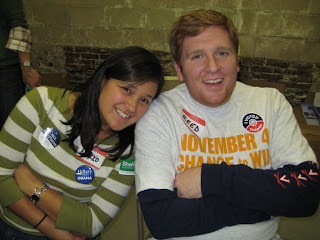
Some pictures below are from the Manchester, N.H. Obama headquarters this past week, and are of the team that worked tirelessly in the waning hours of the election.

359 Elm Street Obama HQ
Manchester, New Hampshire
November 3, 2008

Note: Despite all the technology involved in the Obama campaign, the biggest cheers in the campaign office came when a volunteer dialed down the "campaign clock," ripping down an hour and bringing us closer to "victory." I took this picture shortly after 8 p.m. on election eve from a phone bank table. I was calling Obama supporters at the time to encourage them to vote and see if they needed rides.


Ryan Fitzgerald and Dee Barkett
Manchester, N.H.
November 4, 2008

Note: Our job on election day was to distribute materials to canvassers leaving to hit the streets of Manchester and surrounding neighborhoods.

Nikko Mendoza and Reed Passafaro
Manchester, N.H.
November 4, 2008

Saturday, November 08, 2008

What a Country!

Line at my polling location
Outside the West End Library
Cambridge Street, Boston
6:45 a.m.
November 4, 2008

Reed Passafaro, fellow Obama volunteer, raised a glass to me on election night at The Mission Bar in the Mission Hill neighborhood of Boston.

"What a country," he toasted, a reference to the late Tim Russert.

"What a country!" I replied.

Tim Russert is no doubt smiling in heaven this week. For Republicans and Democrats alike, the 2008 Presidential election proved to the world how great America really is. More people voted this year than in any election in U.S. history, and when all is said and done, election turnout will be higher than in any election since 1960.

Senator Barack Obama became President-elect Barack Obama at precisely 11 p.m. eastern time on Tuesday, when the networks projected that he would win California's 55 electoral votes. Fittingly, the networks that have been analyzing and re-analyzing this amazing race to eager consumers-- well, they all stopped talking. And for five minutes we listened to cheers in Chicago, Atlanta, Los Angeles and New York. We quickly saw a makeshift celebration outside the north entrance of the White House.

A catharsis was at hand.

Regular readers know I voted for Barack Obama. Beyond my vote, I worked more for Barack Obama than for any other Presidential candidate in my lifetime. It started back in February, when I knocked on doors in the Boston neighborhood of Back Bay the weekend before the Massachusetts Presidential Primary. I traveled to New Hampshire four times to help with canvassing efforts there, including Monday and Tuesday of this past week.

Beyond campaigning for Obama, I also helped Sonia Chang-Diaz and her campaign team in the Mass. 2nd Suffolk Senate race. It created quite a schedule for me during the final two days of the election season, with travel back and forth to New Hampshire, periods spent hanging signs, making phone calls, and driving volunteers to canvassing turfs. And of course, twenty minutes
out of my schedule to vote in Boston on election morning.

During the final weeks of this election season, it was hard not to get caught up in the wave of excitement about Barack Obama. There were so many examples of the ebullience for change-- a feeling that overflowed in those five minutes after he was pronounced President-elect.

  • In Alabama last week on the way to Panama City, I was stopped by two Georgian residents who asked me where I got the Obama sign I had taped to my window. They wanted to buy one.
  • On the phones on Monday, I reached an 18 year old woman and asked her if she was planning to vote on Tuesday. "OH, yes," she exclaimed. "I am planning to vote. Let me just walk through with you my schedule so you know exactly when." I really didn't care about her schedule, but I let her walk through it with me, since it sounded therapeutic for her.
  • Waiting for volunteers at my car pool meet up location on Beacon Hill, runners and joggers would flash a thumbs-up when they spotted my Obama sign. Cars driving buy would honk their horns, and it wasn't even like I was trying to be seen.
  • On the street corners of Manchester, an average of 10 Obama volunteers could be seen at busy intersections holding signs and chanting "Yes, we can."
  • Late on election eve, while hanging signs at polling locations in Mission Hill, a random stranger came up to me (I admit I was a tad alarmed) to simply ask me what time the polls opened in the morning. Another told me he was voting in the election for the first time

Putting aside the winners and losers of the election, I think we can all be proud of what happened this past week. I remember four years ago, staring out into the void of space and trying to figure out what country I was living in. I could not understand how America could have re-elected President George Bush. I faced the reality that too many across this land just did not agree with the things I believed in. That perhaps I was just hopelessly out of touch.

Looking at the thousands of cheering faces this past Tuesday, I recognized America again. And I like what I saw.

What a country!

Thursday, November 06, 2008

A Week in Review

What a week. Since I last posted, I have been pretty busy. I know that's not an excuse, but I ask for a little leniency. : )

Here are the headlines:

1) Senator Wilkerson was arrested. I took off from Logan airport last Tuesday (with one week to the election), and ahead of me was an aggressive schedule of travel for work, pleasure and campaigning (more on that later). While I was in the air, my State Senator, Dianne Wilkerson, was led out of her home in handcuffs. She was arrested for allegedly accepting payment in exchange for advocating on behalf of night club owners who hoped to earn a liquor license in Boston. The significance for me? Well, since July I have been volunteering for Sonia Chang-Diaz, Dianne Wilkerson's opponent for the senate seat. I took a day off work during the state primary in September to support Sonia Chang-Diaz at a phone bank in Boston.

Despite losing the primary, Wilkerson planned to challenge Chang-Diaz by asking her supporters to write Wilkerson's name on the ballot. Despite being arrested, Wilkerson amazingly kept campaigning (or at least kept her campaign going) until Friday, when she finally suspended her efforts (an announcement she made when I, fittingly, was also in the air).

2) I witnessed Barack Obama while on the road and in the air. I traveled to San Francisco for work, and I took a couple pictures of evidence.


Woman watches Senator Obama speak to a crowd in Pennsylvania
Aboard a Jet Blue flight to Oakland from Boston
October 28, 2008

A co-worker at my company's west coast office
San Francisco
October 28, 2008

3) My friend Annmarie Connors completed an Ironman. On Friday of last week, I flew to Atlanta and drove to Panama City, Florida, to watch my friend participate in the Florida Ironman. Kim McCrossen and I got to see Annmarie on the route several times as she swam, rode and ran ridiculous distances. I am so proud of Annmarie, and she clearly did something that I could never imagine doing (not the first time I have said that about her). She's been training with her teammate, Victor Acosta, for a year. From a selfish perspective, I am happy the Ironman is over, since it means I should be able to see Annmarie more (and actually buy her an alcoholic beverage).


Annmarie and Victor on the beach at the start of the 2008 Florida Ironman.
Panama City Beach, Fla.
November 1, 2008

4) I hit the campaign trail on Monday in New Hampshire. On Sunday, the Sonia Chang-Diaz campaign released me, a fancy way of saying that since Wilkerson had stopped campaigning, the Chang-Diaz campaign no longer needed me on election day. This freed me to volunteer for Barack Obama Monday and Tuesday. I traveled to New Hampshire with other volunteers from Mayor Thomas Menino's office (Mayor of Boston). We helped set up a staging location (fancy name for a place where volunteers pick up information to knock on doors) on Monday, and on Tuesday, we helped operations at the main volunteer location on Elm Street in Manchester.

5) All of my causes on election day succeeded. It was the best election day for me since 1996, when I was in D.C. on the Boston University program there, and Bill Clinton was re-elected President. That was my first Presidential election. It's been rough going since then.

This year, Barack Obama was elected. Sonia Chang-Diaz was elected as my new State Senator. And Massachusetts voters turned down Question 1, a reckless proposal to eliminate the state income tax that actually had a chance of passing a few weeks back. Success on all three of my priorities for the election. I am a tad giddy.

Sunday, October 26, 2008

It's Always Morning in America

The AP released a poll last week about the state of the economy in this country. One notable summary paragraph, from the AP account:
People are skittish about the economy’s immediate future. Ask how things will be in a year and you hear a different story — and a remarkable show of optimism despite economists’ widespread expectations that a serious recession is brewing.
Americans are certainly an optimistic brood. After all, we come from a lineage of frontiersmen. Our ancestors picked up and moved west just because they believed they could make something of themselves. Our more recent citizens struggled to get here; in some cases risking their lives walking through deserts to realize their own American dreams.

We have always been the nation of a Jack Kerouac-style open road mixed with an overzealous, naive Jimmy Stewart and Frank Capra.

So it should be no surprise to anyone-- certainly not me-- that in the closing moments of the 2008 campaign, Americans are choosing optimism over experience.

I would never expect Senator Obama to steal President Reagan's "morning in America" line, but it's fitting that the Democratic campaign has adopted a former Republican theme song at its rallies: "Only in America," by Brooks & Dunn.

Nine days to go.

NOTE: Excerpt from "Poll shows U.S. nervous, optimistic on economy," October 23, 2008.

Friday, October 24, 2008

It's Time to Vote: Things to Remember

I authored an article on voting for the Beacon Hill Times, on behalf of the Beacon Hill Civic Association, that will appear next week. It's below in its raw, unedited form. I figure it might provide some tips to those voting in Massachusetts on November 4.

NOTE: These tips apply to Massachusetts voters only (more specifically Boston). Rules might vary in other states.

------------------------------------

Beacon Hill, it's time to vote. Beyond the civic reasons, many people in various levels of government pay close attention to who votes. By voting, we increase our voice to our elected officials.

That being said, below is a list of eleven tips related to the voting process. On Beacon Hill, we vote at one of three voting locations, depending on which part of the hill you live on: City Hall, The West End Library on Cambridge Street, and at the Firehouse on Mount Vernon. As noted below, your voting location depends precisely on where you live.

Here goes:

1) Polls are open from 7 a.m. until 8 p.m. on Tuesday, November 4. That's more than twelve hours to find the time to vote. Boston election officials are expecting a huge turnout. Lines are not too common, believe it or not, except at the beginning of the day. And if you are in a line, make friends with your neighbors.

2) Don't forget to read the entire ballot. Obviously, there is a lot of excitement this year to vote in the Presidential race. However, there are other items on the ballot that are of significance to Beacon Hill voters. For example, three ballot questions have spiked quite a bit of debate, including Question 1, which if passed would eliminate the state income tax. Roughly 2/3 of the neighborhood also has a contested State Senate race on the ballot.

3) For absentee ballots, don't forget proper postage. One stamp will not suffice to mail absentee ballots to City Hall. Correct postage is is 59 cents, and to be safe, affix two regular first-class stamps.

4) If you make a mistake at the voting booth, you can request a new ballot. Voters sometimes make mistakes. They misread a ballot, or they drop their pen, and it leaves a stray mark. If this happens, you can ask the warden in the polling location or an assistant for a new ballot. They will mark your original ballot void and give you a new one.

5) If they say you can't vote, don't just walk away. Polling officials have received elaborate instructions on what to do should a voter arrive who is not listed on their voting lists. No polling official wants to deny you the right to vote. They can call Boston City Hall for you. Depending on the rules, you are allowed to cast a ballot provisionally even if you are not listed on the voter roles. You made the effort to get to the polling location; don't leave unless your ballot is cast.

6) Don't wear any political buttons, t-shirts, etc. into the polling place. Technically, you are not allowed to advertise for anything related to the election, including candidates, positions on ballot questions, etc., while you are inside the voting booth. You are allowed to bring in notes and other information to help you vote the way you'd like.

7) Volunteers outside cannot block your way into the polling place. It is completely legal for individuals to stand outside the voting booth, hold signs, advocate for a candidate or position, and to give you literature. However, they cannot harass you. If you had trouble getting to the voting location, tell the warden inside. Their job is to protect your right to vote.

8) If you suddenly are going to be out of town on election day, you can vote in person at City Hall during normal business hours the week before the election. Typically you have until noon the day before the election, and the Elections Department is even willing to make special appointments. Call the Elections Department for more information at 617-635-3767.

9) "Where do I vote?" is a very common question. Your polling location is specific, because it relates directly to where you live. You cannot vote in any other location. Period. Not anywhere else in Boston, and certainly not anywhere else in another city or town. If you are concerned about where you should vote, call the Elections Department at 617-635-3767 and they will tell you. There is also a very simple way to look up your own information through the City of Boston website (http://www.cityofboston.gov/elections/voter/). You can use the website to verify your registration and your polling location.

10) If you are in line when the polls close at 8 p.m., you still have the right to vote. If it's 7:59 when you arrive, and you see a line, don't walk away. The warden will look at the line when the polls close and will mark the spot at the end of the line. Remember, the warden wants you to vote, and if you are in line, they are happy you are there.

11) Take your time. You can spend as much time as you want inside the polling place and reading your ballot. If anything is confusing to you, ask the warden.

Enjoy the experience. Remember, every election is historic in its own way. Be a part of it!

Sunday, October 19, 2008

The Red Sox are not the lead news story today

Colin Powell's endorsement of Senator Barack Obama is the current lead story on Yahoo! News. It is definitely the biggest headline across the nation this Sunday. The decision dominated the conversations among my siblings and parents, when I went to Connecticut today for a small family gathering. My parents, who one would know from reading this blog are Obama supporters, wondered if the endorsement is a nail in the McCain campaign's coffin.

News everywhere, except in Boston. On WBZ-AM radio at 10:30 a.m. this morning, the top news story was the Boston Red Sox. The Powell endorsement played second fiddle to players on a baseball diamond. In fact, it took seven minutes into the news broadcast for WBZ to mention the endorsement. As we all know, the Red Sox are a win away from another trip to the World Series.

It reminds me of a poll the Boston Globe conducted online about this time four years ago. The Red Sox were in the World Series, having defeated the New York Yankees in seven games to win the American League pennant. The poll asked visitors what they would rather see happen: The Red Sox winning the World Series or Senator John Kerry defeating President Bush in the election.

The Red Sox World Series victory won the poll overwhelmingly. The election again was second fiddle. Shocked, I dialed up one of my close friends; one of the smartest people I know.

"How could people not have their priorities straight?" I asked.

"Umm. I think I want the Red Sox to win, too," was the answer.

Red Sox fans got their wish. The Red Sox won the World Series in 2004, and again in 2007. The Curse if the Bambino ended, and all celebrated. Meanwhile, George Bush won a second term as President.

Now, I like baseball as much as anyone else. I plan to watch Game 7 of the ALCS tonight, and I look forward to the World Series. But I turned on WBZ radio this morning in my car to hear about Powell's endorsement. The Red Sox win really wasn't high on my priority list.

I am sure local TV stations in Boston paid even less attention to Powell's decision than WBZ radio. And that to me is both disappointing and scary.

It's especially disappointing given what I witnessed yesterday in New Hampshire. I spent the day canvassing for Barack Obama, Jeanne Shaheen (who's running for Senate) and Carol Shea-Porter (who's running for re-election to Congress). When I returned to the campaign office, I sat across from a young Army veteran who was calling other vets to urge them to support Obama. His speech would have certainly convinced me. He had recently returned from the front lines.

I think it's important for us all to keep things in perspective. The Red Sox victories are a cause for joy, but they should not overshadow what is real news. And the real news is this: In about two weeks we're all participating in what could be the most important election ever.

Facebook as a Mirror on Lives

I first signed up for Facebook in the middle of last year, and since then, it has been an experiment for me. I work in high-tech marketing, and many of my co-workers and clients have asked, repeatedly, how Facebook and other new-media tools fit into their programs. Being on Facebook, and Twitter, and some of the other social media tools, allows me to best respond.

At the same time, my work and non-work lives have overlapped. My friends on Facebook are a combination of current and former co-workers, old and new friends, classmates from the Norwich Free Academy and Boston University, and acquaintances I met on the various campaign trails and in my neighborhood.

There are good and bad things about being connected. First and foremost, Facebook, and this blog, allow me to update several people at once. I remember when a few friends of mine would send update letters in the mail on their lives. Typically timed to the holidays, the letters would give a snapshot into new homes, new travels, and new careers. I can't imagine ever having to write a series of letters, given the new media tools available (I do, however, enjoy writing holiday cards).

I feel like I am continuing several relationships in parallel over Facebook. How else would I know of my former high-school classmates that now have babies? How would I know about good news from the people who have shaped my life over the years?

When I see updates from co-workers on Facebook about feeling ill or having to do weekend chores, it allows me to pick up conversations instantly in the hallway. A trend I have seen is making significant announcements, such as wedding engagements, on Facebook. In my work, we talk a lot about simultaneous disclosure, where public companies are required to give important information to all audiences at the same time. How many times have I gotten into trouble for forgetting to tell certain people about news in my life. How neat is it to potentially say, "Hey, I decided to tell everyone on Facebook, and since you're a friend of mine on Facebook, you found out at the same time as everyone else."

Saturday, October 11, 2008

Vote No on Question 1 in Mass.

This country's founding fathers set up a system of government that in some ways insulates the people from decision making. Done on purpose, our system ensures that the masses are represented, and not that the masses make decisions. The opposite approach, illustrated by the fabled New England Town Meeting, gives everyone a vote, and lets the population decide.

Growing up in a farm town in Connecticut, we had town meetings. Everyone would gather in the elementary school gym, and everyone would vote, up or down, on the budget. I was able to go to one such meeting before I moved to Boston to go to college. They are pretty neat.

Question 1 on this year's Massachusetts ballot demonstrates to me how our founding fathers were right, and how the masses can cause problems for our system. Question 1 eliminates the state income tax, stripping billions (with a b) of dollars out of the state budget. I am voting "no" on question 1, and I hope my neighbors across the state will do the same.

The fact that Question 1 is on the ballot is concerning. After all, to an average Joe-Six-Pack voter, of course you would vote to get rid of the income tax. It gives the people back a lot of money. It makes the politicians work to cut the budget to make the difference. With the broader economy uncertain, as an understatement, money in everyone's pocket is just what the doctor ordered.

Except were not talking about a modest cut here. We're talking about a question that would eliminate more than 12 billion dollars-- 40-percent-- of the state budget. The only way Massachusetts would make the difference is with significant cuts to cities and towns; and those cities and towns would have to raise their property taxes significantly.

Also, passing Question 1 is not a statement; if the question passed it would become binding. It would become the law of the state. The devastating affect on schools and our state's infrastructure is frankly unimaginable. In addition, passing the question would lead to job losses-- state workers who would be laid off.

In other posts on this blog, I have expressed disappointment with proposals by some of our state politicians on how to fix the budget problems in Massachusetts. Casinos, for example, are a band-aid approach. And while I do not have answers to the budget problems myself, stripping 40-percent of the state budget is not the answer either. It does not send a statement. Instead, it punishes everyone, including our children.

Question 1, in and of itself, is a reason to vote in November, even though the fate of the Presidential election here is not in doubt.

Last week, I volunteered to make some phone calls asking neighbors to vote NO on question 1. Thankfully, all those I spoke to understood that there is only one word that can characterize the question, and that word is "reckless."

If you live in Massachusetts, please vote NO on Question 1 this November.

Sunday, October 05, 2008

New Hampshire For Obama

(L to r) Reed Passafaro, Dave Levanto, Bonnie Levanto, Me, Nikko Mendoza
At the Obama coordinated campaign staging location
Manchester, N.H.
October 4, 2008

My parents came to Boston this past weekend to volunteer for Barack Obama. We drove to Manchester, New Hampshire on Saturday for a day canvassing there, walking door to door to identify Obama supporters and to persuade those still undecided.

Together with good friends Nikko Mendoza and Reed Passafaro, we piled into my Honda Accord, and traveled to two separate neighborhoods in Manchester. A couple of observations:

1) Finding a voter is good, but getting the yard sign commitment is a home run. Reed and my mother teamed up, and they worked out quite a system. Not only did they quickly identify Obama supporters, my mom would gently ask if the supporter wanted a yard sign.

2) There are still undecided voters in New Hampshire. Amazing to me, but they are still out there. I wonder sometimes what would get them to ultimately make up their minds. One voter I spoke to supported Hillary in the primary campaign and now only knows she will not vote for McCain.

3) The Obama campaign had a lot of snacks. Everything from donuts and muffins to rice cakes. It was an impressive spread. After canvassing, we stopped by a coffee hosted by Ethel Kennedy, where they had even more food.

4) Canvassing is tiring. My parents stayed at my apartment for the night after returning to Boston from New Hampshire. I could not stay awake past 10 p.m. Crazy!

5) Some canvassing acronyms we came up with to qualify houses before we went to their doors:
  • HPODS (pronounced H-Pods)= High probability of door slam. I actually had one door slam and one window slam on the canvass route. A classic HPODS house is one with a large fence and a "Beware of Dog" sign.
  • HPONOH (pronounced H-ponough)= High probability of no one home. A far more common classification, generally made if you saw no cars in a house's driveway.