George Stephanopoulos put it best this morning when he said that Tim Russert believed in an educated electorate, and he made us believe that too.
I met Tim Russert in October of 2004, when I was at a Boston bar following a Red Sox game. His son Luke was a freshman at Boston College. I told Tim (I joked with friends after meeting him that "Tim and I were close") that I admired how well he researched his interviews.
"Meet The Press" was the first show I ever recorded via Comcast DVR. It was a staple of my viewing each Sunday. And the reason was Tim Russert. He asked the questions that deserved answers-- and he asked them not in the "gotcha" style of a journalist looking to "trip-up" an interviewee. He asked them because he believed the answers would best inform the American public.
Tim Russert was a true American. Everyone who watched his show knew he was from Buffalo. He was authentic; a real-life manifestation of WYSIWYG (what you see is what you get).
There's no question I will miss Tim Russert. I remember that back just before I met him, I believe he had just interviewed President Bush from the White House-- a special interview that aired during the week and not on Sunday. I remember feeling relief when I heard Tim Russert was doing the interview. The nation was at war in Iraq. I did not trust Donald Rumsfeld. I knew Tim Russert would ask the questions that were important, and I knew I would leave with a clearer explanation of what was going on. I trusted Tim Russert; I always did.
Sunday, June 15, 2008


Saturday, June 07, 2008
Scenes from the Democratic State Convention
 Tsongas Arena
Lowell, Massachusetts
June 7, 2008
I attended the Democratic State Convention today in Lowell, Mass. I voted for John Kerry to be the party's nominee for U.S. Senate-- in essence I voted that he be re-elected. Kerry won the endorsement of the party, but his challenger, Ed O'Reilly won enough of the vote to force a primary in September.
 As a member of the 2nd Suffolk delegation, I had a very nice spot on the floor of the Tsongas Arena. I rode to Lowell on the commuter rail with Josh Dawson (pictured above), who is the 2nd Suffolk elected State Committee Man. He ended up being the "Teller" for our delegation, meaning he called out the roll and took the verbal vote from each delegate.
The convention was a lot of fun. It was great to chat with fellow Democrats, including Matt O'Mally, State Representative Marty Waltz, and Ward 5 Democratic Chair Rob Whitney, among others.
The two Democratic candidates for the 2nd Suffolk State Senate seat, Sen. Diane Wilkerson (incumbent) and Sonia Chang-Diaz, were among the delegates. I had a chance to speak to both of them. The Ward 5 Democratic Committee will consider its endorsement in that race at its next meeting on June 18. It's time for me to start researching my choice, and the conversations today were a good starting point. I can tell you that both candidates are very gifted, it will be a hard decision, and my fellow committee members and I are being careful in our research and will be careful with our choice. Watch this space; no doubt I will share my thoughts here.

Sonia Chang-Diaz at the Convention
One thing about Lowell: The commuter rail is great to get there, but the bus system-- especially on a Saturday-- leaves a lot to be desired. A group of about 20 delegates who arrived in Lowell on the commuter rail had to wait about 35 minutes for a bus. If we had only known the Tsongas Arena was a mere 15-minute walk away.
Thursday, June 05, 2008
Suffolk and Beacon Hill: Is an Agreement Near?
Big developments this week on Beacon Hill with regard to Suffolk. The first part of this post is the facts as they currently stand. The second part is my opinion. I clearly differentiate the two sections below.
First, the facts. As noted in earlier posts, Suffolk University has filed an institutional master plan (IMP) with the Boston Redevelopment Authority (BRA), and the BRA is accepting public comments regarding that IMP. The IMP is a detailed plan regarding Suffolk's growth and potential development, and the BRA requires the insitution to file it. During this comment period, which is dictated by the BRA, Suffolk has been in near-continuous discussions with the Beacon Hill Civic Association (BHCA). Suffolk was founded on Beacon Hill, and several of its buildings are located on Beacon Hill. Suffolk officials and Civic Association representatives are discusing an agreement between the two parties; in exchange Suffolk asks for the BHCA to support Suffolk's IMP.
As I have posted previously, the BHCA is concerned that the proposed development outlined in Suffolk's IMP (which covers ten years, by the way) will adversely impact the Beacon Hill neighborhood. The BHCA has been negotiating with Suffolk for a series of concessions from Suffolk that would mitigate the University's impact on the residential neighborhood.
Earlier this week, a negotiating team from the BHCA came to an agreement with Suffolk. However, that agreement is not technically accepted by the BHCA until the BHCA's Board of Directors votes to accept it. The next Board of Directors meeting is scheduled for this Monday. So we're currently in a limbo period, as the agreement is on the table and is waiting for final approval from the board.
A Boston Globe article this week would indicate that the agreement has been made and is behind us. In reality, the board still has to accept it, and the board meeting on Monday promises to be very contentious. Needless to say, Suffolk will be a hot topic of conversation this weekend around the neighborhood.
------- Now time for my opinion ----------
The Agreement Should Pass
Unfortunately, I will be out of town Monday night, traveling on business. As a BHCA board member, I support the current agreement on the table between the BHCA and Suffolk, and I would support it if I were able to attend Monday.
With the current agreement, Suffolk makes significant concessions to the neighborhood. Suffolk agrees not to build any building across almost the entire neighborhood, and the agreement places significant restrictions on what Suffolk can do with other buildings in the neighborhood. The agreement includes a process to ensure that Suffolk does not increase its student population beyond the figures noted in the IMP. It also includes a signficant pledge to try to house as many students as possible in dorms by the end of the IMP's 10-year coverage period.
Finally, Suffolk agrees to continue many of the programs it has instituted over the past few years to police and mitigate rowdy student behavior in the neighborhood.
On paper, Suffolk is making more concessions in the agreement than many other institutions in the city. To be fair, there is a reason for this. Suffolk does not have the best track record regarding adherance to previous planning documents. The student population at Suffolk has increased far more rapidly in the past few years than Suffolk had predicted.
Suffolk students live on Beacon Hill, and they play here. But they are also my neighbors. I have worked side-by-side with them during Beacon Hill clean up days. I have strung garland on lamp posts with them during the annual neighborhood decorating day. I recently spent time outside with them watching a total lunar eclipse. Always an optimist, I believe there's a way to harness the energy and ideas of these students to better the neighborhood. It would be a shame if they weren't here.
We cannot expect Suffolk to leave. But we certainly should expect them to take a proactive role in the neighborhood. I hope that Suffolk will continue to be active on Beacon Hill. I look forward to working with them in the many months that come.
Saturday, May 31, 2008
Endorsement: Senator John Kerry
A week from today I head to Lowell for the Massachusetts Democratic State Convention, where I will represent the second Suffolk district as a delegate.
At the convention, delegates will be asked to nominate a candidate for the U.S. Senate seat currently held by Senator John Kerry, whose term expires in early 2009. I will vote to nominate Senator Kerry.
While this may not be a surprise to many who are not even sure there's a choice this year, it comes after a week of research that included conversations with both Senator Kerry and his Democratic opponent, Ed O'Reilly. My reasons for supporting Senator Kerry are as follows:
1) Cape Wind. Ed O'Reilly does not support it. Senator Kerry is still undecided, depending on the outcome of a study into the environmental impact of the project. I support Cape Wind, and believe it should have been approved long ago. The opposition to the project is based on the legitimate claims of many who live near the proposed off-shore wind farm or will be affected by it. However, their claims are significantly overridden by the potential benefits of the project. A wind farm, whether privately operated or not, is the type of alternative energy project that the United States should be investing in and promoting. While I wish Senator Kerry would support the project, at least he doesn't oppose it.
2) I am fine with Senator Kerry's position on the Iraq war. Ed O'Reilly sees this as a wedge issue; in particular, Senator Kerry's vote in favor of the resolution that ultimately (but not explicitly) led to the war. In reality, Senator Kerry was one of the first Senators to vote on a timeline for U.S. troop withdrawal. He made a commitment at a meeting with convention delegates today to continue to oppose funding for a long-term presence in Iraq. I actually am not completely in favor of a deadline for withdrawal, and I think the larger issue in play is the U.S. relationship with the world, and the fact that we need to change the way the world looks at us (John Edwards words, not mine). Regardless, I trust Senator Kerry on this issue and am not swayed by Mr. O'Reilly's points.
3) Senator Kerry is not complacent. I am not a fan of Democratic convention delegates picking nominees. While I am proud to be a convention delegate, true democracy demands that all Democrats have a say in who the party nominee is. This naturally means I would support Ed O'Reilly. If he receives 15 or more percent of the delegates at the convention, then party rules dictate there will be a primary. And with a primary all Democrats have a chance to vote to pick the nominee.
Except I don't see a reason for a primary this year, because Senator Kerry is as engaged as he always has been in the causes of Massachusetts. Having already established that, on the issues, I think he's the better candidate, I don't see a reason to extend this process any further. To go further, as Senator Kerry noted today, Democrats have a huge chance to make gains in the Senate and House, and he can help in that effort. I see no reason to deter from that effort by forcing a primary. While I would never, ever call a primary a distraction, the choice for Massachusetts Democrats this year is just too overwhelmingly clear to delay the selection of our pick.
I enjoyed meeting Ed O'Reilly this week and appreciated his hospitality. I trust he is a great man and a fantastic attorney. But I see no reason this year to take the junior Senator seat away from John Kerry.
Monday, May 26, 2008
Opening the Cottage
 Levanto Beach Cottage
South Lyme, Conn.
May 25, 2008

View from the front porch
David Levanto after pasta dinner
South Lyme, Conn.
May 25, 2008
Saturday, May 24, 2008
Ear Pain
I have a special relationship to my ears. I have had ear trouble my entire life. As a child, I would regularly suffer from middle ear infections. By the age of five I could pronounce "Amoxicillin" without even hesitating; that was the normal prescription when my ears would be in pain.
Ear infection pain is hell. There's no other way to describe it. Beyond the fact that the pain is a combination of a throb, a burn, and being poked by a needle, it frustrates you. You have the consistent belief that you can reach into your ear and cover the pain. Except it's on the other side of the ear drum. That doesn't stop you from trying, poking your finger into your ear as far as possible, only to come away disappointed each time.
As a kid, I had ear operations a number of times to insert "tubes." Literally the tube creates a tiny hole in the ear drum that relieves pressure on the inside of the ear, and allows fluid to drain straight outside. The tubes worked, except it meant you had to plug your ears when you swam to protect the vital inner section of the ear.
Needless to say, throughout life I have gotten pretty good at self-diagnosis. About eight or nine years ago, I suffered an ear infection while at work. I could tell. For me, besides the pain, when I have an ear infection I walk funny (an ear infection affects my balance). I calmly called my doctor, who was on call, and said, "I have an inner ear infection and need you to prescribe me some Amoxicillin." The doctor, who I had seen only twice since starting my job, was pretty amazed. He quizzed me for a bit about my condition (as if Amoxicillin is a controlled narcotic or something), until I finally said, "Trust me doc, I have been here before. I know my ears well."
I am not sure, in reality, why my ears are bad. I think it has to do with the development of the Eustachian tube, which is the passage way that connects the inner ear to one's nose (it's what is supposed to allow air to escape from the ear, serving the natural purpose of the artificial tube in the ear drum). I think my Eustachian tube is different from other adults. It doesn't stay clear as much. And when it's blocked, like after a fairly minor cold, my ears pay the price.
My ear history comes into play during what is becoming a fairly common part of my job lately. Flying. Flying is harsh on a person's ears, due to the change in air pressure on ascent and descent. This week, I had a trip to Austin, Texas, and over last weekend, my ears were blocked. I knew this was a problem. I had heard stories of people who blew out eardrums because their ears were blocked while heading in for landing.
I had talked to my ear, nose and throat specialist about this possibility. The flippant nature of his advice is something I will never forget. "Well, if you're ears are blocked, you shouldn't fly [Have you ever heard of anyone giving this excuse for not going on a trip?]. But if you must, then take some Sudafed, use nose spray a few hours before you change altitude, and we'll just hope for the best."
I was forced to hope for the best this past Wednesday and Friday, when I flew to and from Austin. Fortunately, the regiment my specialist prescribed worked. The flight to Austin was rather painful in flight, but the descent went fine. My jaws were rather sore on landing from how aggressively I chewed gum on the plane (chewing gum moves the jaw, which causes the Eustachian tube to open and equalizes the ears). Driving around Austin, my ears were not in pain, but they were sore, kind of like as if they were trying to figure out what I had just did to them.
By the way, my current primary care doctor tells me that Sudafed is not good to take, since it raises blood pressure. Sudafed and I have been friends since I was old enough to swallow. If my doctor is in the process of ending that relationship, them's fightin' words.
Avoid Getting Burned
In Austin, Texas this week for work, my co-worker and I drove by a church with a sign that said:
"Exposure to the Son helps you avoid being burned."
You got to love Texas. In reality, I really do like Austin quite a bit.
"Exposure to the Son helps you avoid being burned."
You got to love Texas. In reality, I really do like Austin quite a bit.
Sunday, May 18, 2008
Sunday is Football Day
For the last seven years, I have played football on Sundays in the coed Boston Ski and Sports Club league. Not only is it good to be active at least one day of the week, but football Sundays are a good reason to catch up with friends.
Over the course of several seasons (I play in two separate seasons each year), friendly rivalries have developed. Today witnessed the latest chapter of the showdown between my team (called "The Beer is Always Cold" and the "Pocket Rockets."
After the game, we all went to Donahue's in Watertown to watch the first half of the Celtics vs. Cavaliers game.

Representatives from the "Pocket Rockets" vs."The Beer is Always Cold"
Donahue's Pub
May 18, 2008
It's perhaps fitting that we played to a draw on the field. Ties are allowed in my league.
Suffolk University and Beacon Hill
Each night the last week I attended at least one local civic meeting or event. The most important, in my opinion, was a public meeting hosted by the BRA on Thursday regarding Suffolk. I posted earlier that Senator John Kerry was to speak at the Ward 5 Democratic Committee meeting that night. Senator Kerry had to cancel, which allowed me to attend the Suffolk meeting instead.
To recap, Suffolk is currently writing a new Institutional Master Plan (IMP), an important document required by the Boston Redevelopment Authority to outline Suffolk's plans for development for the next ten years. Suffolk is discussing the plan and working through issues with a task force, organized by the BRA, of neighbors, city officials and Suffolk executives. Suffolk submitted its IMP for review in mid-April, and there is a sixty-day review period. The meeting this past Thursday was an opportunity for the public to give its feedback to the IMP and ask questions.
The reason Suffolk is causing problems is classic "town and gown." Many of Suffolk's buildings are on Beacon Hill. Suffolk students walk around the neighborhood, eat here and live here. Suffolk has grown quite a bit in the last five years or so, meaning more students are here. Some students are pretty bad neighbors.
Suffolk wants to continue to develop its facilities and programs, and it likes being located in downtown Boston. Many that live near Suffolk buildings feel that the institution has too much of a negative impact on the neighborhood. Some even believe Suffolk should sell its buildings on Beacon Hill and move away.
Here are my thoughts on the topic:
1) I have not been to every Suffolk meeting. I went to the public meeting Thursday, and previously went to a public meeting in late January. I can tell you one thing. Suffolk is trying very hard to work with the neighborhoods. I saw significant evidence that they are willing to compromise with Beacon Hill. They have proposed enlarging the current non-expansion zone in place on Beacon Hill to include, among other spots, the area where the 100 Cambridge building is and where the Bowdoin Street condominiums are. That's important to me.
2) Key to the debate is the definition of expansion. Suffolk currently has roughly 5200 students. Actually they record them as "full-time-equivalent" students-- or "FTE's"-- a number that is a tad lower than the actually student number. Suffolk currently has an enrollment of about 4800 FTE. Per the IMP, they want to stop growing at 5000 FTE. This means while the FTE number has grown significantly over the past five years, it's not going to grow that much more. It follows to me that the number of students around Beacon Hill is not going to increase much in the coming years.
Now there are a lot of hidden aspects to the FTE number, some of which I am still investigating. Like how much of the FTE number is commuter students, or students who don't need to live anywhere near the campus. If the commuter percentage decreases, it follows that more students will be living near the campus. In addition, Suffolk doesn't have a good track record holding to FTE promises made in previous IMPs. Suffolk acknowledges this and says it will stick to the number.
3) Are students *really* that bad? I live on the north slope of Beacon Hill, near many younger residents. I rent, and this side of the hill has more rental properties that are less expensive, relatively speaking. I hear loud parties all the time, because on Beacon Hill, we all live on top of each other. But I am not sure how many of the parties are actually students. Many are, I am sure. But how many are young professionals like me? Is the issue here one of working with students and enabling them to be better neighbors, or is it an issue of engaging younger, mostly single, residents? How are those two issues related? How much of the reaction to the Suffolk issue is really evidence of this larger issue?
I don't think Suffolk should move off of Beacon Hill. I think they have a place here. I appreciate what they've done to try to compromise with the neighborhood. There's rhetoric on either side. I can say at this point, if Suffolk agrees to enlarging the non-expansion zone and really agrees to cap its FTE growth numbers, I think they will have done quite a bit to limit the impact of their plans on Beacon Hill.
Saturday, May 10, 2008
Beacon Hill Civic Association Board Meeting Monday
This Monday marks the end of my fifth year on the Beacon Hill Civic Association board. I have told the board's officers that I would like to continue for a sixth year, and I hope they will nominate me to serve the next term (each board member serves for a term of only one year).
The final meeting for this term is going to be busy. According to the board packet I received on Friday, the board will be voting on the fate of Phillips Street Park. The City of Boston intends to refurbish the park and has allotted money to do so. Over the last year, a public process has created a compromise design for the park. It includes a playground for children and an area for common use. It's not perfect, but it meets the needs of a huge variety of people, and I intend to support it on Monday. Given that I have been to all of the Phillips Street Park meetings, I am hoping that my opinions are valid.
Also at the meeting, board members will hear the latest related to Suffolk and the university's institutional master plan (IMP) process. From the packet, it appears that the board will be voting on the IMP at the next meeting in June. The timing is important here, since in June, we will be into the next board term and will inevitably have new faces among us. The next board is formally elected at the annual meeting, which is later this month.
Separately, I am planning to attend the Ward 5 Democratic Committee meeting Thursday. Loyal readers know I was elected to that committee in February per the results of the Massachusetts primary. Senator Kerry is expected to speak, and the ward committee will decide whether to endorse a candidate in the Presidential Democratic primary race.
All told, a nice week of civic involvement for me...
Absolutely No Momentum
There's no difference between no momentum and "absolutely" no momentum. The term "absolutely" is a useless word, prime to be struck by my editing pen. But I mention it here for emphasis: The 2008 Democratic Primary campaign has shown absolutely no momentum for either candidate.
Obama voters have voted for Obama. Since Super Tuesday, this category includes African Americans, younger voters, and those who make more money and have completed college. Clinton voters have voted for Clinton. Since Super Tuesday, the Clinton voter is typically blue-collar and/or older. Clinton has also done well among women, unless they are African American, and her support in this category wanes among younger women and among women who've completed college (since that would overlap with a demographic favorable to Obama).
In contest after contest since early February, the make up of either candidate's support has not changed. Each primary is a census on a given state's make up against those demographics. We now know that the younger or college-educated Democratic audience in Indiana is almost the same size as the blue collar or older one.
I admire the fact that Democrats across the country have stuck to their hunches. They have not been swayed by talk of momentum (proof there hasn't been any). From a broader perspective, the way the media has covered this race is humorous. Under the no-momentum theory, a casual observer could have predicted a Clinton victory by ten points in Pennsylvania back in February. It's just the way the demographics in Pennsylvania fall, and the way the "Democratic census" in that state would work out. Yet the morning after, we heard pundit after pundit saying that Hillary had momentum. We heard it for a week.
Truth be told, the media are dieing to say that someone, anyone, has momentum. Because a horse race with no race is boring. After Pennsylvania, many reporters couldn't wait any longer, and proclaimed that Clinton had finally received the big "mo."
Except they were wrong. The results in North Carolina and Indiana are exactly as one would have predicted back on Super Tuesday, looking and the Democratic make-up in each state. At that time, you could have called North Carolina for Obama by a dozen and said Clinton would win Indiana by a couple.
But while the results showed no momentum, the media said the opposite: That Obama had momentum and the race was over. We heard Tim Russert say early Wednesday morning that we now know who the Democratic nominee will be.
While Obama might readily win the nomination, he has not picked up any momentum from Tuesday's victories. New polls today from West Virginia show Clinton extending her lead there. Using the theory of no momentum, let's make some predictions on how the remaining contests will unfold. To do this, I will look at the demographics of each state versus the results on Super Tuesday (yes-- results from early February). Here goes:
1) Clinton wins West Virginia by 24.
2) Clinton wins Kentucky by more than 20. Could even be 30.
3) Obama wins Oregon by 7.
4) Obama wins Montana by 9.
5) Clinton wins Puerto Rico by 12.
6) Obama wins South Dakota by 6.
Let's see if I am right.
It's important to call each primary what it is. They are not snap-shot polls of the electorate. They are reflections of the unique demographic mixes of each state. When Clinton wins West Virginia on Tuesday, it will not be because she has momentum and has won over voters, it will be because the group of voters that she appeals to will be much larger. We shouldn't read more into it than that.
Monday, May 05, 2008
Tribute: Dr. Donald "Robbie" Robinson
Last summer the History Channel produced a series on the ten most important dates in American history you never heard of. Each episode focused on one event that had a profound effect on how we live today. For example, one episode was on the famous Einstein Letter, which many argue is the reason the United States developed the atomic bomb. And the rest is history, as they say.
If I were to put together my own list of the dates that have, to this point, most affected the course of my life, I would definitely mark down the random day in April 1996 that I met Dr. Donald "Robbie" Robinson. He and his wife were the directors of Boston University's Washington D.C. program, and my meeting with Dr. Robinson was a pre-requisite to being accepted into the program.
Based on that interview, Dr. Robinson not only accepted me into the D.C. program for the Fall of 1996, he recommended I be placed as an intern in the White House, where I would work for then Vice President Gore. I will never forget the unwavering confidence he had in me that day. Without his help, both in terms of that confidence, and his Rolodex, there's no way I would have interned in the White House.
No doubt during his more than 25-year tenure as the head of the D.C. program, Dr. Robinson personally affected the lives of hundreds of young Americans, not to mention, grew one of the most successful programs of its kind in the country.
I learned last week that Dr. Robinson passed away at the end of April at the age of 71.
Saturday, May 03, 2008
Boston Civic Summit
I attended the Boston Civic Summit today. While I do enjoy any reason to visit the sparkling new Boston Convention and Exhibition Center, I was not expecting to spend most of the day there. The summit turned out to be a fairly good event.
The best measure of civic involvement in Boston is by counting people who vote. Turnout in Boston in November of 2007 was 14 percent (of registered voters). That's pretty bad. This year, turnout should be high, since we're in a Presidential year. Maybe it will even reach 60 percent (it was in the high 50s in 2004).
What I find ironic about this is that the great majority of issues I hear every day from Boston residents are local issues. Crime. Education. Picking up trash. These are issues that are not really addressed by the President of the United States. They are issues that are addressed by the Mayor and Boston City Councilors. Yet, turnout this November for the Presidential election could be three times as high as turnout will be in November 2009, when Boston will elect a Mayor and the entire slate of City Councilors. For the election that really matters for the issues my neighbors care about, no one will bother to vote.
In some ways I like that Boston has off-year municipal elections. Since so few voters actually go to the polls, the people who do vote are *really* important. Local candidates work very hard to figure out who they will be-- based on voting records for similar municipal elections. The flood of auto calls and literature I receive ahead of these elections is pretty impressive.
Back to the civic summit. In my opinion, the afternoon was better than the morning. I got a chance to chat with Adam Gaffin, who runs Universal Hub, about better ways for me to get his site Beacon Hill information, without causing extra work for him.
The lunch talk was outstanding. Dr. Thomas Sander, who is the Executive Director of the Saguaro Seminar at Harvard, discussed the need for social capital. The fact that social capital within neighborhoods is what creates trust and improves quality of life. The fact that cities with high social capital are just bound to be nice places to live. The fact that as residents we need to "bond" to neighbors who resemble us and "bridge" to neighbors who don't look like us.
The best part of the talk was at the end. Eva Webster, who's with the Aberdeen-Brighton Residents Association, made a passionate plea for all to bridge social economic classes in our neighborhoods. I hear her. Beacon Hill isn't exactly known for being diverse in this regard.
After the lunch talk, the 400+ participants held a town meeting of sorts. It was a little long, but the format resulted in a few near-term civic initiatives that should be goals for the entire civic summit:
Overall, I had low expectations for the event, and I was pleasantly surprised. It was refreshing to see so many people talking about ways to make Boston better without complaining all the time. The passion was contagious.
Michael Pahre files his report here.
The best measure of civic involvement in Boston is by counting people who vote. Turnout in Boston in November of 2007 was 14 percent (of registered voters). That's pretty bad. This year, turnout should be high, since we're in a Presidential year. Maybe it will even reach 60 percent (it was in the high 50s in 2004).
What I find ironic about this is that the great majority of issues I hear every day from Boston residents are local issues. Crime. Education. Picking up trash. These are issues that are not really addressed by the President of the United States. They are issues that are addressed by the Mayor and Boston City Councilors. Yet, turnout this November for the Presidential election could be three times as high as turnout will be in November 2009, when Boston will elect a Mayor and the entire slate of City Councilors. For the election that really matters for the issues my neighbors care about, no one will bother to vote.
In some ways I like that Boston has off-year municipal elections. Since so few voters actually go to the polls, the people who do vote are *really* important. Local candidates work very hard to figure out who they will be-- based on voting records for similar municipal elections. The flood of auto calls and literature I receive ahead of these elections is pretty impressive.
Back to the civic summit. In my opinion, the afternoon was better than the morning. I got a chance to chat with Adam Gaffin, who runs Universal Hub, about better ways for me to get his site Beacon Hill information, without causing extra work for him.
The lunch talk was outstanding. Dr. Thomas Sander, who is the Executive Director of the Saguaro Seminar at Harvard, discussed the need for social capital. The fact that social capital within neighborhoods is what creates trust and improves quality of life. The fact that cities with high social capital are just bound to be nice places to live. The fact that as residents we need to "bond" to neighbors who resemble us and "bridge" to neighbors who don't look like us.
The best part of the talk was at the end. Eva Webster, who's with the Aberdeen-Brighton Residents Association, made a passionate plea for all to bridge social economic classes in our neighborhoods. I hear her. Beacon Hill isn't exactly known for being diverse in this regard.
After the lunch talk, the 400+ participants held a town meeting of sorts. It was a little long, but the format resulted in a few near-term civic initiatives that should be goals for the entire civic summit:
- Establishing a civic association exchange program,
- Improving the after school mentoring and tutoring program,
- Enhancing the summer employment program for at-risk kids, and
- Creating a city-wide litter and anti-graffiti program.
Overall, I had low expectations for the event, and I was pleasantly surprised. It was refreshing to see so many people talking about ways to make Boston better without complaining all the time. The passion was contagious.
Michael Pahre files his report here.
In London an Undershirt is not Required
 Covent Gardens, London
April 27, 2008
Work sent me to London for nine days in April. Despite the fact we speak the same language, England and the United States are quite different.
1. In England, they don't wear undershirts. It is quite uncool to wear a white t-shirt under a button down, collared shirt. I wear one all the time, primarily because I don't think many appreciate seeing my chest hair or the sweat under my arms. In England, apparently these items show off virility. I can imagine the pheromones released on a hot summer day, when a virile man emerges from the underground and is dripping with sweat. And supposedly they are the civilized ones?
2. A cigarette is called a fag. This one I find particularly humorous. But perhaps more troubling is the fact they call erasers rubbers. I told everyone not to ask loudly for one in an American store.
3. There's no such thing as a shower curtain. Puzzling, but on my few occasions to London this is a common trait. The shower is really a nozzle that is useless unless it occupies one hand. More strangely, the only water barrier is a small, glass divider that only progresses less than half way down the outside of the tub. Water inevitably splashes all over the floor.
4. You are not fired in London. You are sacked.
5. You order "to take away," not "to go." I found it quite annoying that in any coffee shop, deli or even McDonald's, they ask you if you are eating in or "taking away," and they are incessant on the answer. Then I learned that London has an extra tax if you eat your food in an establishment, versus ordering it to go.
6. The overhead compartments in airplanes are called lockers.
7. Man flu. England is much less PC than the U.S. It's almost accepted that men can't handle pain as well as women. A co-worker of mine came down with a bout of the "man flu" while I was there, which is basically the flu, but apparently it's supposed to inspire more empathy because it's flu afflicting a man.
8. In the U.S., the sense of a nation is far more pronounced. OK, here's where I throw in my comparative political lesson. I was quite surprised that in London, there is more of a connection to England than the United Kingdom. After quite an argument with another colleague, I admitted that England is actually a country, as is Wales and Scotland. In London, they cheer for the English soccer team. I found the regional affiliations to be far more pronounced than in the U.S. When I was in central Europe in December, I did not see many German flags (many Bavarian ones, but no German).
This same barometer is applied to the U.K. I saw far more English flags than U.K. flags. Now this could be because I was in town during the week of St. George's day, but I think there is something more to it. Unlike my previous trips to London, this time I stayed away from the tourist hotspots and remained in the neighborhoods, so I think this observation carries more meaning.
9. One sunny day a week is just fine. In London, they must have found a cure for seasonal affective disorder. It was sunny for exactly one day. Luckily it was a Saturday, so I could enjoy it by taking the train to Brighton on the coast. The weather in London, like the local food, is horrible. Enough said.
My favorite place in London is officially the Punch & Judy pub in Covent Gardens. The pub isn't much-- it reminds me of a Boston college bar (I could even smell vomit inside). But the view is amazing.
 Punch & Judy balcony
Covent Gardens, London
April 27, 2008
I stayed in a "flat" rented by my company in Connaught Village near Marble Arch. There was a pub right across the street called the Duke of Kendall pub. Every Sunday, a wonderful old woman comes to the pub to play the piano, with wise gentlemen surrounding him to create a sing along. I have no idea what they sang, but the site mesmerized me. I took the picture below from the elevator lobby down the hall from the flat on my final day in London. Note it's raining.
 Duke of Kendall Pub
Connaught Village, London
April 29, 2008
Saturday, April 12, 2008
Electric Car: Something I Could Never Do
I have three brothers, and we all do different things.
My oldest brother Mark is a school administrator in Connecticut. Before that, he was a math teacher.
My youngest brother Brett is in grad school in Virginia. He's married to a Navy officer. They both graduated from George Washington University (Brett with a degree in History).
I work in public relations outside Boston.
And my next older brother Scott, he turns gasoline-powered trucks into electric cars.
 Scott is a brilliant inventor and mechanic. He knows engines and cars like the back of his hand. He's always the first person I call when something weird happens with my Honda (which lately has been often).
Scott owns a marine engine dealership in Mystic, Conn. Recently, the New London (Conn.) Day published a story on how he was hired to turn an old Chevy truck into an electric green-friendly car. It's an amazing story.
What I find so interesting is one of the reasons he did the job was to practice. Marine engines are gas-guzzlers. The time is coming when boat owners will want to conserve money and make their boats re-chargeable. I can't imagine any other person is more knowledgeable on how to make this happen than Scott. Al Gore, if you're out there, maybe you should give him a ring?
NOTE: Photo taken from The New London Day, April 11, 2008. Photo Credit: Tim Martin, The Day. Original Caption: Scott Levanto, a mechanic at Masons Island Marina in Mystic, raises the hood on the 1989 Chevy S-10 pickup that he converted to run on power supplied by 20 electric batteries. The truck, owned by Orin Robinson of Mystic, can travel up to 40 miles on a single charge.
Mid-Majors Can't Win National Championships
When Kansas won the NCAA national championship Monday night, I was celebrating 38K feet above ground. Work had sent me west, to San Francisco, for the annual RSA IT security conference. My flight conveniently took off three hours before the championship and landed about an hour after it finished.
I was happy Kansas won. I told my old roommate Blake earlier this year that there is no way a mid-major conference team can ever win an NCAA championship. Maybe it was a visceral comment, but I felt strongly all year that Memphis was overrated. Whenever a team has to go around saying they are ready for the tournament because they played nine non-conference games against other teams that made the tournament, you know there's a problem (Hint: None of Memphis' fellow Conference USA teams made the field of 65).
Memphis' biggest game of the year was against Tennessee, and they lost. Tennessee, in my opinion, was also overrated, because its conference, the SEC, had a down year. So the alleged best team in the country played one good team all year-- a team that was also overrated-- and that team won.
My NCAA bracket reflected my distaste for mid-majors. I had Memphis losing to Michigan State in the round of 16. I had Tennessee losing relatively early too (I was right there).
Why am I down on the mid-major conferences? The NCAA basketball season is long, unlike its sister football season, and the NCAA playoffs are long as well (also contrary to the football season). The point of a long season is to prepare a team for the post-season. Playing in a major conference, against opponents that are national caliber, day in and day out, prepares a team for the big dance.
Being a UCONN fan, I naturally favor the Big East. But I certainly respect many other conferences (even though I hope their teams lose to Big East foes). The ACC. The Big 10. The SEC (even though this was a weak year for that conference). And last but certainly not least-- the Big 12.
The Big 12 has had it rough for a long time. It's tough to find their games on national TV (thank you ESPN for being an exception). The conference tends to represent midwest schools that favor the pigskin over the three-point stripe. There's only one problem: Big 12 basketball is really fun to watch. The teams are well-matched and very talented. The style reminds me a lot of the Big East, and so I like watching Big 12 games.
I have also always favored Big 12 teams heavily in the NCAA tournament. And it's usually cost me. I had Texas winning the national championship last year-- that didn't work out. Before Kansas' victory Monday, the Big 12 had only won a single national championship in the last like 50 years.
So why did Memphis lose on Monday? Fittingly, it's because the team broke down in the final moments of regulation. Missed free throws. Not fouling when Kansas needed a three to tie (by fouling, they could only get two free throws). These are the types of mistakes made when you win every regular season game by 50. These are the types of mistakes you make when you don't play national caliber teams every night. These are the types of mistakes made by a mid-major conference team.
When Chalmers hit the three for Kansas to tie the game with less than five seconds remaining in regulation-- sending the game to overtime where everyone knew Kansas had the momentum-- I nearly jumped out of my United Airlines seat. My friendly pilot had placed the Westwood One broadcast of the game on the inflight radio system. I could even hear the pilot changing channels as we cruised out of range of a certain frequency. I certainly would have rather watched at home in front of my HD screen, but since the color commentators were Billy Rafferty and John Thompson (the dad), it wasn't all that bad.
I imagined that we were over the state of Kansas when the final horn sounded, and the Jayhawks captured the crown for the Big 12 and major conferences everywhere. I am sure bedlam reigned in Lawrence (as Brent Musburger would have said). And the Kansas faithful should know that high above them, in a Boeing jet sailing west, this major-conference fan was indeed smiling.
Sunday, April 06, 2008
The Road to Denver
I have never been to Denver. Well, I have been to the airport, but not to the city. This August is looking like a great time to go.
Yesterday, a large group of my Democratic neighbors in the Massachusetts 8th Congressional District elected my good friend Nikko Mendoza to be a delegate to the Democratic Convention, which is in Denver this year in late August.
It was a long but exciting day, and another lesson for me in democracy. A few general observations:
-- The Bunker Hill Community College has a grilled cheese sandwich vending machine. The caucus I attended last night was in a BHCC auditorium. In the main lobby, where I was greeting caucus-goers with other Nikko supporters, a hot food vending machine offered the cheesy treats along with french fries and pizza. Curiosity overtook me. I tried a grilled cheese. Not horrible, but I am not about to buy one of the machines for my apartment.
-- We Democrats know how to demonstrate the chaotic side of the process. I remember watching some of the Iowa caucuses on TV. The Republican caucuses seemed neat and orderly, with people sitting in chairs and casting votes by dropping a paper in ballot box slots. Pretty uneventful TV. The Democratic caucuses were kind of like a cross between an organizational PTA meeting and a baseball game. Organized chaos, perhaps. The caucus yesterday at the BHCC was organized chaos. Matt O'Mally, one caucus organizer and recognized party member, wasn't even listed on the voter registration lists. Despite this, I was disappointed that many attendees got upset. As Democrats, we should know by now that we excel at organized chaos (See: Texas prima-caucus [Prima-Caucus is a new word for me!]).
-- I really like the community side of politics. It was truly great to see local Charlestown neighbors coming out to support John "Jack" Kelly, who was running on the same slate as Nikko. (Jack grew up in Charlestown). The community feel of the event was overwhelming, and great to see. I have often said that Boston is a city of neighborhoods, and it was great to spend a day in an adjacent neighborhood to where I live.
After the caucus, I went to the Mission on Mission Hill, where I ran into some Obama supporters just exiting their 8th Congressional Caucus. Unlike the Hillary caucus, which ended on one ballot, the Obama caucus went on forever.
I am also very proud of Nikko. She really deserves to be a delegate, as I have written earlier, and it's great to see her recognized for her efforts.
P.S. For anyone who really is interested, Nikko won with 85-percent of the votes cast. As I screamed after the results were announced "LANDSLIDE."
P.P.S. It's great to see extensive coverage of the caucuses yesterday in today's issue of Boston's hometown newspaper, The Boston Globe, given that the events were the big political news in the city of the last month. (For those who can't read my tone, the Globe didn't cover them at all.)
Tuesday, April 01, 2008
Cruel

Some metered spots on Beacon Hill switch to resident parking at 6 p.m. and remain resident-only from 6 p.m. until 8 a.m. I parked in one of these metered spots at 5:54 p.m. this past Friday. I returned thirty minutes later to find the ticket above on my windshield.
Check the time. The parking officer gave me a ticket 39 seconds before 6 p.m. Thirty-nine lousy seconds.
Granted, I was parked illegally. I will pay the ticket. But I have to take a minute to register a complaint with Boston transportation (BTD).
Here goes: There is a section of Beacon Street along the Common that is resident parking after 6 p.m. Before 6 p.m. parking is only allowed for state house press. There is signage clearly indicating that state house press can park before 6, and residents can park after 6. If I try to park on this street on a Saturday, they will give me a ticket. Even if there are no other cars on the street (e.g. plenty of parking for state house press), I get a ticket.
Fair enough. Except the majority of the time when I try to park on this street after 6 p.m., there are several state house press cars still parked. In many cases, especially during the spring, the combination of state house press cars and visitor cars parked illegally means I cannot find a spot at all.
Why doesn't BTD ticket these cars, which are also parked illegally, as vigilantly as they ticketed my car this past Friday, a mere 39 seconds to victory?
Cruel, I tell you. Cruel.
Monday, March 31, 2008
Caucus Saturday: I am Supporting Nikko Mendoza
This Saturday I am attending a district Democratic caucus in Massachusetts. I am supporting my good friend Nikko Mendoza, who is running to be the female delegate for Hillary Clinton representing the 8th Massachusetts Congressional district.
A couple of things that are strange about this.
1) I didn't vote for Hillary Clinton in the primary. I voted for Barack Obama.
2) I don't live in the 8th Congressional district. I live in the 9th Congressional district. I can't even vote at the caucus I am attending Saturday.
These strange things should show you how strongly I support Nikko. To say she is a dedicated public servant in her role within Mayor Menino's office is an understatement. Nikko is on call 24-hours a day, 7-days a week for the people of Boston.
Furthermore, to say that Nikko is a dedicated supporter of Hillary Clinton is also an understatement. She helped organize ground efforts in Manchester, New Hampshire when Hillary was way behind in the polls there (She even inspired me to drive up there and help her).
She volunteered in Rhode Island on the second Super Tuesday, placing phone calls to Texas towns when the victory in Providence was secure.
Now for those of you who want a little bit of education about how the delegate selection process works in this state, here it is in simple terms. The Presidential primary on Super Tuesday determined the delegates awarded to Senator Obama and Senator Clinton. However, the delegates are awarded by Congressional district. In the 8th Congressional district, Senator Obama won seven delegates (and alternates) and Senator Clinton won two delegates.
Once the total count is determined, each congressional district holds caucuses to determine which individuals will fill the elected delegate positions. Each candidate holds a caucus. So in the 8th Congressional District, the Obama campaign and the Clinton campaign are holding separate caucuses.
At the Clinton caucus in the 8th district, the attendees will elect one female and one male delegate to the convention in Denver in August to fill the seats the primary voters gave the Clinton campaign in February.
Confused yet?
Simply put, in my case, I cannot think of a better delegate to represent me and my Democratic party than Nikko Mendoza. And I am looking forward to supporting her on Saturday even though I cannot vote for her. Anyone else who is a registered Democrat in the 8th District (meaning your Congressman is Mike Capuano), please join me in supporting her. The caucus is being held at Bunker Hill Community College in Charlestown. Also-- You should know that her full name on the ballot is Marie Nicole Mendoza.
8th Congressional District DNC Caucus for Hillary Clinton
Saturday, April 5 at 1PM (please arrive no later than 12:45PM - doors close promptly at 1)
Bunker Hill Community College
250 New Rutherford Avenue, Charlestown
Saturday, March 22, 2008
Managing Boston Common Use
Local papers and bloggers are buzzing after news broke last week that the City of Boston Parks Department is considering kicking certain large events off the Boston Common. I have had a pleasant experience working with the Parks Department on issues related to the Common, and thought I would post my thoughts.
The Boston Common is a sacred space, and it is heavily used. With that use comes damage. I attended meetings this time last year with the Parks Department, as they planned to shut down the parade ground space on the Common to rehabilitate the turf (the parade ground is generally the area right above the Boston Common Garage. The project was not cheap, and for that reason it makes complete sense for the department to evaluate use of the parade grounds, and the entire park itself.
There are too many events on the Boston Common. Some of these events would benefit from switching their location to the City Hall Plaza area. For one thing, the T access to City Hall Plaza is immediate. Plus, the buildings around City Hall Plaza are a natural noise container. You do not know how many times I have heard that the noise on the Common is excessive-- and that noise travels right into the homes on the south slope of Beacon Hill.
In summary, given how much the City has spent on repairs to the Boston Common, it is the Parks Department's responsibility to taxpayers to evaluate use of the park to make sure the refurbished areas remain pristine for years to come.
Saturday, March 15, 2008
Mr. Levanto Goes to City Hall
This past Tuesday one of the Boston City Council's committees held a hearing on towing policies in Boston and their affect on keeping the city's streets clean. Since I have been involved in this issue (fortunately or unfortunately) since I first volunteered in Beacon Hill, I decided I would got to the hearing to testify.
I took a half day off and decided to take a tour of City Hall in the process. Some of my friends work there, and I always like to meet my elected officials. In the morning, I stopped by the office of John Connolly, newly elected City Councilor at large. Mr. Connolly is a very hard worker-- I have heard anecdotes that he gets to the office early and stays very late. During my visit, he commented that he's been studying the budget process-- He's on the Ways & Means Committee.
I voted for John Connolly and can say, following my visit with him, that I am happy I did. We talked for twenty minutes about hot topics on Beacon Hill, many of which I have written about on this blog. I also mentioned to him that I had recently cheered on a basketball team of fifth graders (coached by my good friend Jen) who are from his home neighborhood of West Roxbury. New piece of Boston knowledge: "The 'Parkway' includes both Roslindale and West Roxbury-- the team in question was from Parkway.
I then went to the Council Chamber and attended the hearing. Here's a quick summary of my testimony: Street cleaning works, and towing cars for the sweeper is a great idea. There's a discussion underway about making street sweeping in Boston a year-round program. I think that's a great idea. Street sweeping is overwhelming effective, but it's worthless unless the street sweeper can reach the curb. Making the program year-round will be tricky, given that-- among many reasons-- there sometimes will be snow on the ground. But we can work through those issues. If you are still reading this (bless you), you can email me to learn more on this.
Wednesday, March 12, 2008
A Campaign Without Momentum
I have been talking to a lot of people lately about how the current Democratic primary race has shown no momentum for either side. I usually say this in the context of the way the media is covering the race.
I usually tell the story this way: If you had predicted, based on the way certain demographics voted on February 5th (Super Tuesday), the way things would have unfolded in this race, you would have said:
Given this is exactly what has happened, how can anyone say that either side has momentum?
Dan Kennedy wrote a much more eloquent entry on this point, which is worth a read.
By the way, for further evidence of the lack of momentum in this campaign, look at when voters in Mississippi made up their minds. Way more than half of them said they made their choice more than a month ago. How does that support the claim of momentum for Obama the media is talking about this morning? (I heard the "momentum" word on WTKK during the drive to work.)
I usually tell the story this way: If you had predicted, based on the way certain demographics voted on February 5th (Super Tuesday), the way things would have unfolded in this race, you would have said:
- Clinton loses the 11 contests between Super Tuesday and the primaries in Ohio and Texas.
- Clinton wins Rhode Island, Texas and Ohio but loses Vermont.
- Obama wins Wyoming and Mississippi.
Given this is exactly what has happened, how can anyone say that either side has momentum?
Dan Kennedy wrote a much more eloquent entry on this point, which is worth a read.
By the way, for further evidence of the lack of momentum in this campaign, look at when voters in Mississippi made up their minds. Way more than half of them said they made their choice more than a month ago. How does that support the claim of momentum for Obama the media is talking about this morning? (I heard the "momentum" word on WTKK during the drive to work.)
Monday, March 03, 2008
Certified Results
I received an official letter from the City of Boston on Saturday that read:
"You are hereby notified that it appears from the results of the February 5th, 2008 Presidential Primary, that you were elected to the Ward 5 Democratic Committee for the City of Boston."
I wonder if the elected Mayor of Boston receives the same type of letter?
So I guess that means my election has been "certified"? : )
Thursday, February 28, 2008
Beacon Hill's Latest Thoughts On Suffolk University
The Beacon Hill Civic Association (BHCA) submitted its written concerns regarding Suffolk University's Institutional Master Plan Notification Form (IMPNF) in a letter to the BRA yesterday. Translation: The largest and primary civic organization on Beacon Hill has noted some issues it has with what Suffolk has said about expansion plans for the next 10 years.
I am sure the letter will be posted soon at the BHCA website, and as a board member to the group, I was involved to some extent in the creation of the document. Here are some interesting observations:
1) The letter notes a few areas where Suffolk didn't really follow the plans laid out in its previous Master Plan, which has expired. It notes how Suffolk grew a lot faster than it was expecting when the plan was accepted, among other things. This is important since Suffolk states in the IMPNF that it is capping enrollment for the next ten years at 5K students (well, they call them full-time-equivalent students, but let's just say it's the same). I was not on the BHCA board when the previous Master Plan went into effect, so I tend to believe Suffolk when it says it will stop at 5K students. I can see how some of my fellow board members, who have served much longer, are skeptical.
2) In general, the letter from the BHCA asks for a lot more detail. More detail about enrollment projections. More detail about the expected changes and alterations to buildings on Beacon Hill that Suffolk already owns. More detail about specific community relations programs that Suffolk is planning to mitigate the impact of students living, studying and playing on Beacon Hill.
The letter leaves a window open to Suffolk. The letter concludes: "While Suffolk has fully expressed its desire for expansion, the IMPNF is not adequate to support the proposition that its rapid growth can be accommodated in and near existing residential areas, without substantial harm to the residential communities. The additional information, disclosure and analysis that we request will assist in review of Suffolk University's proposals."
The IMPNF is "not adequate." My understanding is that the document Beacon Hill is responding to is a notification form-- not a full Master Plan. It's just the beginning. It follows that if Suffolk makes the Master Plan "adequate," the Civic Association *might* support it.
That being said, at its board meeting 10 days ago, which I attended and noted previously on this blog, the BHCA passed a policy of standing opposition. The mountain to climb for Suffolk is tall.
On the other hand, as someone who is always optimistic, it's to be noted that the BHCA submitted a separate letter to the BRA today that expressed non-opposition (which in Beacon Hill speak is not the same as support) for Suffolk's dormitory project in the Downtown Crossing area, near the Modern Theater and Suffolk's 10 West Street dorm space. This is also a residential area, by the way.
Other town-and-gown watchers in Brighton have praised what Suffolk has done in Downtown Crossing as a model for other institutions, such as Boston College, to follow. They have noted how Suffolk has paid close attention to the residents since its plans for the dorm at 20 Somerset Street were squashed amid the concerns of the Beacon Hill community and others. [The IMPNF proposes that the 20 Somerset building be used as a new location for an existing art school-- The New England School of Art and Design.]
If Suffolk were to work with the BHCA in response to the letter issued today, is there a chance the BHCA's board could ultimately support the final Master Plan? As a board member and someone who believes Suffolk has a place in my neighborhood, I say, "why not?"
NOTE: Letter excerpt taken from "Re: Suffolk University Institutional Master Plan Notification Form dated January 11, 2008," signed John Achatz, Chairman, Beacon Hill Civic Association and dated February 27, 2008.
Thursday, February 21, 2008
Sec. Galvin Should Have Stuck to His Hunches
In May 2007, Massachusetts was set to hold its primary on March 4, 2008. Mass. Secretary of State William Galvin admonished his counterparts at certain states, such as Florida, since they were moving up their primary dates (as Massachusetts ultimately did). This is what he told the New York Times:
Here we are in February 2008, and Galvin was right on the money. As much as I liked to vote on Super Tuesday, how neat is it for voters in Texas and Ohio, who could possibly participate on the last primary day that means something this election season?
EDITORS NOTE: Text pulled from: New York Times, "Seeking an Edge, Florida Changes Its Primary Date," May 4, 2007
In May 2007, Massachusetts was set to hold its primary on March 4, 2008. Mass. Secretary of State William Galvin admonished his counterparts at certain states, such as Florida, since they were moving up their primary dates (as Massachusetts ultimately did). This is what he told the New York Times:
Though Florida meant to pump up its importance in the primaries, it might have done better sticking to March, said William Galvin, the secretary of state in Massachusetts and leader of a National Association of Secretaries of State committee that opposes the movement toward earlier primaries. If no candidates emerge as clear front-runners after the ''super-duper'' primary on Feb. 5, Mr. Galvin said, states that vote later could prove pivotal.
''This is kind of like the track touts trying to figure out what's going to happen at the Kentucky Derby,'' he said.
Here we are in February 2008, and Galvin was right on the money. As much as I liked to vote on Super Tuesday, how neat is it for voters in Texas and Ohio, who could possibly participate on the last primary day that means something this election season?
EDITORS NOTE: Text pulled from: New York Times, "Seeking an Edge, Florida Changes Its Primary Date," May 4, 2007
The Today Show Visits Sugarbush
I learned to ski at Sugarbush back in 2001, thanks to the generosity of my good friend Tom Hopcroft. Many have commented to me since then that Interstate 89 (which runs diagonally through New Hampshire) is the highway that connects Boston to Sugarbush.
It is exciting that the Today Show decided to visit. Take a look at one of the broadcasts below.
Monday, February 18, 2008
Thoughts from the Beacon Hill and National Trails
I was in Austin, Texas this week for a few days for some work meetings. Along the way, I mentally put together a post that updates everyone on what I have been working on as well as gives my current thinking on this amazing election we're in the middle of.
Before I talk about the national campaign, I want to note for a second a debate that is raging in my neighborhood of Beacon Hill in Boston.
It's about Suffolk University. A week ago, the Beacon Hill Civic Association, of which I am a board member, passed a policy that notes specific concerns regarding Suffolk's proposed expansion in downtown Boston. I supported the policy, and I am happy the board passed it, since things could have been far worse. A bit of background:
-- Suffolk is in downtown Boston, and it is trying to grow. A few of the University's buildings are located in Beacon Hill. The neighbors on Beacon Hill are wary of Suffolk's plans to expand, given the stressed nature of "town-and-gown" relationships in other Boston neighborhoods. It follows that every loud party on Beacon Hill over the past few years has been blamed on Suffolk.
-- Suffolk is in the middle of laying out for Boston its plans for the next several years, in a document called an Institutional Master Plan. The process has been rocky, primarily because no one on the Beacon Hill Civic Assocation belives Suffolk and vice versa. I have been trying to formulate my own opinion, and I have found that means listening to the civic association, and listening to Suffolk, and then shooting for the middle of both arguments.
-- Many in the neighborhood simply want Suffolk to leave. Literally, they want Suffolk to sell their properties here and move to some other part of Boston. I saw a draft policy that discussed this last week. Umm. This is a tad scary. What would be next? My neighbors decide that they also want renters like myself to move on, preserving the neighborhood for property owners?
All this being said, here's what I think: Suffolk is an asset to Beacon Hill in many ways. I want the institution to grow and continue to contribute here. That means Suffolk must detail in a very comprehensive way how its expansion will impact the neighborhood. Which means Suffolk needs to admit there will be an impact. Suffolk must use additional drafts of its new master plan to lay out specifics. And I am happy to help them in this process. Finally, I don't think it's a good idea for Suffolk to just leave the Hill. I for one would miss the institution.
Well there you have it. Now I move on to my points about the national Presidential race:
1) You know everyone is engaged this election season when my football-watching former roommate, Blake, called me on Super Tuesday evening and asked to come over to watch election returns, as if we were watching the Super Bowl. A native of Texas, Blake is always a good one to speak to for a level-set on the election, since he has perspective from outside of the liberal bastion of Boston.
2) The campaign has clearly moved to Texas. There were many ads on TV for both Obama and Clinton that I saw while in the hotel room in Austin. Also, a few people spoke of the debate this week on the University of Texas campus and how there are only 100 tickets. (But there is a debate watching party for all candidates at the Hyatt hotel.)
3) I met with a work-related friend for coffee, and she told me that on Super Tuesday evening, she and her husband went to a wine bar to watch returns. The atmosphere seemed more like a big college football game; when the announcers called a state for a given candidate, cheers would erupt, as if Obama or Clinton were scoring touchdowns.
4) I was up in Vermont this weekend, and at my ski house, debate inevitably moved to the campaign. I have spoken with quite a few women who are not fans of Hillary, which leads me to my next point, a crititque of the media:
5) I think Hillary has gotten a bad rap from the press (and I say this as someone who is supporting Obama). I have heard repeatedly that Obama "has the momentum." In reality, what has happened over the past few weeks is exactly what everyone was expecting. It just so happens that Obama has benefitted from a few states that have his "type" of voters. So he has been victorious. But momentum? Have the pundits seen the latest polls out of the states voting on March 4? Hillary is ahead. If those polls do change, it will only, in my opinion, be because of the so-called momentum they are placing behind Obama.
At the same time, I don't think the media's favoring of Obama is because Hillary is a female. I think it's because she is the "establishment" candidate. How amazing is it that even though she is a woman, Hillary is often picked by those who make up their minds in the voting booth? The reason? As David Plotz noted in last week's Slate political gabfest, it's because Hillary is the "safe" pick. She's the establishment candidate. Unfortunately for her, the media like underdogs or "mavericks." In addition, voters tend to be romantic. They like fresh faces and discussions of hope and change. I have a general theory that voters will pick hope and change over practicality every time. It's a core Amercian fundamental. But that's the topic of another blog post.
Finally, what the heck is wrong with Bill Clinton? Yesterday, I heard that he blamed the recent losses by his wife on well-off voters participating in caucuses who "don't really need a President," but rather have bought into needing change or hope. Is that how he classifies me, an Obama voter here in Massachusetts? I don't understand what is wrong with him, but I am kind of embarrassed.
Kudos to everyone who is acknowledging that today is in fact my 32nd birthday. It's raining here in Boston. Is that a sign? : )
Wednesday, February 06, 2008
Election Hangover
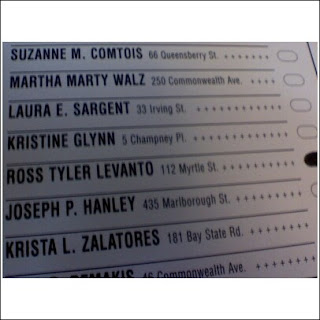
Ward 5 Democratic Ballot, Boston, February 5, 2007
I am pleased that the voters in my ward elected me to the Ward Democratic Committee (there were 35 names on the ballot running for 35 slots, but I am pleased in any event). By the way, don't worry: I did vote for all 35 of the ward committee candidates nominated by my ward (the vote cast above is just for effect).
I wonder how many people actually saw my name?
So what's next? Well, for me, it's back to watching Chris Matthews. My brother Brett gets to vote on Tuesday in Virginia, and he's still undecided.
Monday, February 04, 2008
Obama Has Caught Clinton
(Editor's note: I have endorsed Barack Obama in the presidential race. My reasons are in an earlier post on this blog.)
A new 7News/Suffolk poll has the Massachusetts democratic race a dead heat as we head into election eve. Obama leads by two points, within the margin of error.
Also, I am not sure if it was smart for Senator Clinton to make a remark related to the Pats loss yesterday.
Slate's "Today's Papers" is the first outlet I have seen that notes Obama has caught up to Clinton in national polls.
I should mention that the polls I trust the most are the Reuters Zogby polls. A great story from the 2000 campaign that is more myth than reality (I heard it from a friend so I am not sure if it's true, but it is interesting.) Rogby had been showing in its overnights up to the election that Gore was seeing a late surge. The morning of the election, they calculated their final numbers, and gave Gore a slight win in the popular vote. Seeing this was counter to all other polls, Zogby told his peeps to redo the numbers. They came out the same, and Zogby released them. They ended up being right on the money with the outcome of the election. This part is true, the Zogby poll did correctly predict the outcome of the popular vote.
That being said, some very encouraging signs for Barack Obama in the recent batch of overnight polls. He has pulled into the lead in California. He has pulled into the lead in Missouri. It looks like his victory in Georgia may be of South Carolina proportions. The latest New Jersey poll has the race a tie.
The crowds he is drawing are significant. Thousands yesterday in Delaware. Today, he's in New Jersey, Connecticut and here in Boston.
Friday, February 01, 2008
Endorsement: Barack Obama
I am a sucker for hope.
I am a sucker for hope.
My 11th grade history teacher, Dorothy Agranwitch, made her students keep journals to reflect on world events. After observing a semester's worth of remarks in mine, she inscribed a statement that I will never forget. Written in her elegant, Radcliffe-inspired script, she said, "Your prose and interpretation brings one word to my mind: hope."
It follows suit that I quickly fell in love with Bill Clinton, since he made me believe in sappy things like hope and change. President Clinton ushered in change at a time when we needed it; breaking from the Reagan and Bush years to reinvigorate the country. What follows was laudable: a booming, if not irrational, Internet economy; and a general feeling that this country was the best country in the world. When I authored a column for The Daily Free Press while at BU, my last entry discussed the huge crowds that greeted
At a time when change is once again needed, and for other reasons I detail in this post, today I announce my support for Senator Barack Obama to be the next President of the
Let me say that for many (also sappy) reasons, I am proud of the way things have transpired this primary season. Turnout in the early primaries has been overwhelming. Younger voters, and many previously uninterested, have come out in large numbers. The country is engaged in a way I have never seen before.
We also benefit from a field of impressive Democratic candidates. As the New York Times led its endorsement of Hillary Clinton: "This generally is the stage of a campaign when Democrats have to work hard to get excited about whichever candidate seems most likely to outlast an uninspiring pack. That is not remotely the case this year."
To be sure, Hillary Clinton and Obama share many overall policy objectives, and among the ones I support:
*Universal Healthcare: The healthcare system in the
*Focus on the environment. Having worked for Al Gore, this is a big deal for me.
*Recognizing that the Al Qaeda that attacked us on September 11 is based in
Given the similarities in positions offered by Clinton and Obama, the choice on paper was difficult for me. But a couple of distinctions between the candidates in recent weeks have provided clarity.
First, Obama believes strongly that everyone should have a seat at the table. He understands that the world is more complicated than "with us or against us", and that there is no harm in asking for help to combat the world's problems. Hillary believes this too, but not enough, in my opinion. Her vote to support designating
Senator Edwards impressed me with his commitment to restore
Second, I think the American political scene needs a refresh. President Bush has so damaged America's stead in the world, that I find it hard to believe any connection to politics as usual will be acceptable in the eyes of our International allies. Hillary Clinton to many in the
Finally, as much as I loved Bill Clinton, I can't figure out why he's involving himself in this race. This is Hillary's campaign, and I was impressed by her ability to run the campaign and not rely on the involvement of her husband. The Onion Magazine ran a headline in this week's issue that read: "Bill Clinton: Screw it, I am Running!" In recent weeks, Bill Clinton has shown me that he will be involved in Hillary's campaign and her presidency. Which brings into question: Which Clinton will call the shots in the White House?
I am very disappointed in Bill's words. The inspiration provided by Hillary as the architect of her own success now seems shallow, or at least hollow. Moreover, to relate Senator Obama's success in
Bill Clinton inspired me in 1992. He did so again in 1996 when he ran for reelection. I volunteered for that campaign.
Ironically enough, in 2008, part of Hillary's
Tuesday, January 29, 2008
Close to Decision Time
Florida goes to the polls today, and there's one week left to Massachusetts.
My good friend Kate Strouse Canada sent me her current thoughts on the campaign. I think she provides some great insight. Read on:
Florida goes to the polls today, and there's one week left to Massachusetts.
My good friend Kate Strouse Canada sent me her current thoughts on the campaign. I think she provides some great insight. Read on:
You've asked me a couple times what I think about the Democratic crop of candidates. I've given it a lot of thought this weekend and thought I'd share some of my not yet totally fleshed out thoughts with you.
I like John Edwards and his attack on corporate America and that he truly believes in social service programs and in helping the poor. The poor (and the military) in my opinion have lost the most over the past 8 years and having someone in the White House who will push an agenda to get them back on their feet is really important to me. I also feel like we need someone who will do some sort of "New Deal" policies and I think he's charismatic and likeable enough to get a lot done.
This being said, he's not going to win. He'll probably be a VP candidate again but he just doesn't have what it takes (whatever that is) to do it.
Hillary and Obama have very similar policy positions in my opinion. Hillary is smart, she surrounds herself with knowledgeable, smart people and she knows the system. That being said, she's more of a centrist and, like her husband, will make a lot of compromises to get things done. This isn't always a bad thing. BUT - I struggle with the democratic idea that we would have either a Bush or a Clinton running our country for possibly 28 years. It troubles me a little bit. Of course - if it comes down to Hillary being the nominee it won't trouble me as much as a John McCain or Mitt Romney presidency.
Obama is young, fresh and more of a establishment guy than people give him credit for. He's extremely savvy, has great advisors and comes off as more "real" than the other candidates. Notice I say - comes off as. There is no question this guy isn't a politico. As someone said recently - you don’t become a Senator in a corrupt state like Illinois when you're only in your 40s without knowing how to play the game. I like that he's invigorating youth - and African Americans - to vote. There have been a lot of articles in the Baltimore Sun about African Americans registering to vote and pledging to vote - and they've had African American candidates to vote for before but he's really something different to them. I also really like Michelle Obama. She's tenacious, willing to speak her mind and willing to "go there" on a lot of issues. I don't think his depth of knowledge is as strong as Hillary's and I don't think he'll get a tremendous amount done as President at first, but I think he has the potential.
Given all of that - here is my litmus test. Being a tried and true Democrat it doesn't matter to me policy wise who is the nominee. I will vote for them. BUT - I want someone who will FIGHT. The Republican machine is still strong and still nasty and whether it's Romney or McCain the Karl Rove style of campaigning will still be around in this election. I don't want the Democratic candidate to sit back and not respond when they are attacked - ala John Kerry. If there are questions about race or gender, or service or whatever it is - I want the candidate to fight back and keep fighting until they get their message across. I know Democrats try to be all nice and "inclusive" but the stakes are high this year and this is not the time to sit back and think you're "above that type of politicing". I feel like Hillary will definitely fight. Obama has shown me a little bit of this in the past few days but I need to see more.The other thing I'm hoping is that if Hillary is the candidate, that Obama fights for her. AND - if Obama is the candidate that both Hillary AND Bill fight for him. It has to be unified.
Because another 4, or 8 years, of a Republican (especially John McCain) - would put this country down a very dangerous path, both within our "borders" and across the globe.
Sunday, January 27, 2008

The Presidential Race Shifts Here
Hillary Event Tuesday, I am Still Undecided
I heard Massachusetts mentioned for the first time this morning. Tim Russert talked about how the state is "delegate rich" and is a place where Barack Obama thinks he can win delegates.
Indeed, now it's time for many other states to get involved in the Presidential race. I have still not picked a candidate of my own, but several of my friends are supporting Hillary Clinton. In fact, my friend Elizabeth sent a note about an organizational meeting for local supporters of Hillary Clinton. Hillary won't be there, but some other Boston polticial notables will be. Here are the details:
Where: At the Community Church in Copley Square Boston
Date: Tuesday, January 29
Time: 6 p.m.
It's free to attend. It's meant to be a way to get local Hillary supporters together.
If you have questions you can call Elizabeth at: 508-942-6340.
Tuesday, January 22, 2008
My appearance on Greater Boston
I was on Greater Boston with Emily Rooney on December 10. I talked about trash in Boston. You can watch it by clicking here.
I was on Greater Boston with Emily Rooney on December 10. I talked about trash in Boston. You can watch it by clicking here.
Saturday, January 12, 2008

Subscribe to:
Posts (Atom)


